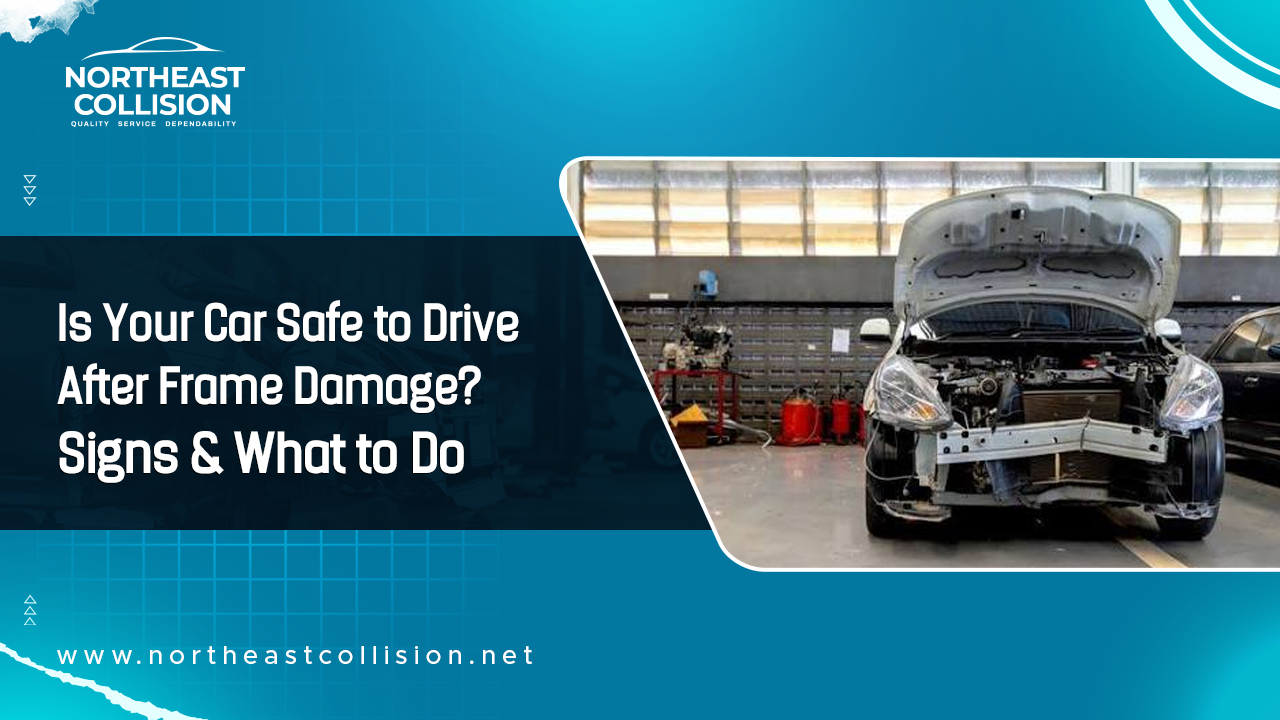
Most people don’t think about their car’s frame until there’s a problem. The frame acts as your car’s skeleton, holding everything together and helping safety systems do their job. After an accident, the frame can shift in ways you might not notice from the driver’s seat, even if the car looks okay.
If you notice any frame or structural damage, stop driving and have a professional check your car for collision services. Even if it drives as usual, a damaged frame can affect your safety, steering, and brakes.
It is generally NOT safe to drive if you notice:
- Doors, hood, or trunk that don’t close flush or line up evenly
- The car pulls to one side or feels unstable at speed.
- Uneven tire wear appears suddenly after a collision.
- Visible bends, kinks, ripples, or rust-through in the frame rails
- A steering wheel that sits off-center when driving straight
It may be safe to drive short distances (to a shop) if:
- The damage is cosmetic, a scuffed bumper cover or scratched panel with no misalignment.
- A qualified technician has confirmed that the frame and unibody are within factory tolerance.
- There are no fluid leaks, warning lights, or unusual noises.
If you’re unsure, don’t take chances. Get your car towed or inspected before driving it far. Frame damage isn’t always easy to spot, and it’s not worth the risk.
Warning Signs of Frame or Structural Damage
Frame damage isn’t always obvious, like a crumpled hood. Sometimes, it appears in small ways days or weeks after an accident. Here are some signs to look for.
1. Uneven Panel Gaps
Check the gaps between your doors, hood, trunk, and fenders. If your frame is in good shape, these gaps should be even. After a collision, even a small one, a bent frame can make panels uneven, cause doors to stick, or leave the trunk crooked.
2. The Car Pulls or Wanders
If your car pulls to one side when you let go of the wheel on a straight road, that’s a warning sign. It could mean the frame is bent, which affects the suspension, not just the alignment.
3. Vibration at Speed
If you feel new vibrations in the steering wheel, floor, or seat—especially if they get worse as you speed up—it could mean a frame or suspension part is out of place.
4. Uneven or Rapid Tire Wear
Tires can wear unevenly for different reasons, but if this starts right after an accident, it’s often because frame damage has changed your wheel alignment beyond what a normal alignment can fix.
5. Steering Wheel Off-Center
If you’re driving straight but the steering wheel isn’t level, something in the frame or suspension may have moved.
6. Visible Bends, Kinks, or Rust-Through
If possible, open the hood and look underneath. Ripples in the metal, sudden bends in the frame, or rusted-through spots all mean the structure may be weakened.
7. Doors or Windows That Don’t Seal Properly
If you notice new wind noise, water leaks when it rains, or doors that are harder to close, the body may have shifted out of shape.
If you spot any of these signs after an accident, get a professional inspection instead of relying on how the car feels.
Why Frame Damage Affects Crash Safety and Handling
Your car’s frame, whether it’s a body-on-frame or unibody, is designed to do two things: keep everything together while you drive and absorb crash energy in a controlled way if you’re in an accident.
Modern cars have crumple zones, which are areas made to collapse in a crash and absorb energy so less reaches the people inside. This system depends on the frame’s original shape and strength.
When a frame is bent, twisted, or improperly repaired:
- Crash protection drops. A frame that’s already weakened or misshapen won’t crumple the way engineers designed it to in a future accident. Energy can transfer more directly to the cabin.
- Handling and braking suffer. Suspension and steering components are mounted to precise points on the frame. If those points shift, your car’s handling becomes unpredictable, and stopping distances can increase.
- Airbags and safety systems may not deploy correctly. Some of these systems rely on sensors positioned according to factory frame geometry. Structural changes can affect their timing or function.
- Long-term wear accelerates. A frame that’s slightly out of alignment puts uneven stress on tires, bearings, and suspension parts, leading to premature failure.
That’s why frame damage isn’t just about looks or whether the car drives. It’s a safety issue that affects how well your car can protect you in another accident.
Can a Car Frame Be Repaired?
Yes, in most cases, frame damage can be fixed, and it’s often less expensive than you might think. The important thing is to have your car frame repaired by a shop with the right tools and training, not just bent back into shape.
How Frame Straightening Works
Professional frame repair typically involves:
- Measuring the damage. Technicians use a computerized measuring system to compare your vehicle’s current dimensions against the manufacturer’s original factory specifications, down to the millimeter.
- Anchoring the vehicle. The car is secured to a frame rack or bench system that holds it firmly in place during the pulling process.
- Hydraulic straightening. Hydraulic rams apply controlled, calculated force to push or pull bent sections back into their correct positions, guided in real time by the measuring system.
- Re-measuring throughout. The vehicle is checked repeatedly throughout the process, not just once at the end, to ensure it’s tracking toward factory tolerances rather than just “close enough.”
- Final verification. Once the frame measures within acceptable tolerance on all key points, the vehicle moves on to panel, paint, and mechanical repairs.
However, not all frame damage can be fixed. If the damage is too severe, if some parts are torn instead of just bent, or if repairs cost more than the car is worth, it may be considered a total loss. Your frame repair shop and insurance adjuster will decide this together, following manufacturer guidelines and the actual damage.
Why a Post-Collision Inspection Matters, Even After a “Minor” Crash
You might want to skip an inspection after a small accident, especially if your car still drives well and the damage looks minor. But frame and structural damage aren’t always as obvious as they seem.
Even a low-speed crash, a bump in a parking lot, or a tap from behind at a stoplight can bend a frame rail, crack a bracket, or move a subframe out of place. This is especially true if the hit is angled or strikes a strong part, such as a wheel or frame rail.
A thorough post-collision inspection typically includes:
- A visual check of the frame, subframe, and structural components
- Computerized measuring to compare against factory specifications
- An alignment check
- Inspection of suspension mounting points
- A test drive to check for pulling, vibration, or noise
If you skip this step, you might end up driving a car that looks fine but doesn’t protect you as well in a crash. This risk often only shows up in another accident.
Also, insurance usually covers this type of inspection as part of a collision claim, so there’s rarely a financial reason to avoid it.
Restoring Factory Specs With Certified Structural Repair
The goal of frame repair isn’t just to make the car drivable again. It’s to restore it to the same structural specs it had before the crash, and that difference is important.
A shop that specializes in certified structural repair will:
- Use OEM repair procedures specific to your vehicle’s make and model
- Rely on computerized measuring systems rather than visual estimation.
- Follow manufacturer guidelines on which components can be repaired versus which must be replaced outright (some high-strength steel components, for example, are not meant to be straightened at all)
- Document before-and-after measurements so you and your insurer have a clear record.
This kind of repair lets your car truly regain its original crash safety, not just look okay on the outside.
If you’re in New Jersey and your car has frame or structural damage after a crash, pick a car frame repair shop that specializes in structural repairs, uses factory measurements, and keeps records. That way, you’ll know your car can be safely and completely fixed.
Frequently Asked Questions
Can a car frame be repaired?
Yes, in most cases. Using computerized measuring systems and hydraulic straightening equipment, technicians can return a bent frame to within factory tolerances. Severely damaged or torn structural components may not be repairable and could result in a total loss determination instead.
Is a car with frame damage totaled?
Not automatically. Whether a car is totaled depends on the repair cost relative to the vehicle’s actual cash value, as well as whether the specific structural components can be safely repaired per manufacturer guidelines. Some frame damage is very repairable; other cases exceed what’s cost-effective or safe to fix.
Is it safe to drive a car with frame damage?
Generally, no, not until it’s been inspected. Frame damage can affect crash protection, steering, braking, and handling, even if the car seems to drive normally. Have it evaluated by a qualified shop before continuing to drive it any real distance.
How is frame damage measured?
Technicians use computerized measuring systems that compare your vehicle’s current structural points to the manufacturer’s original specifications. This shows exactly where and how far the frame has shifted, guiding the straightening process and confirming when the frame is back within safe tolerance.