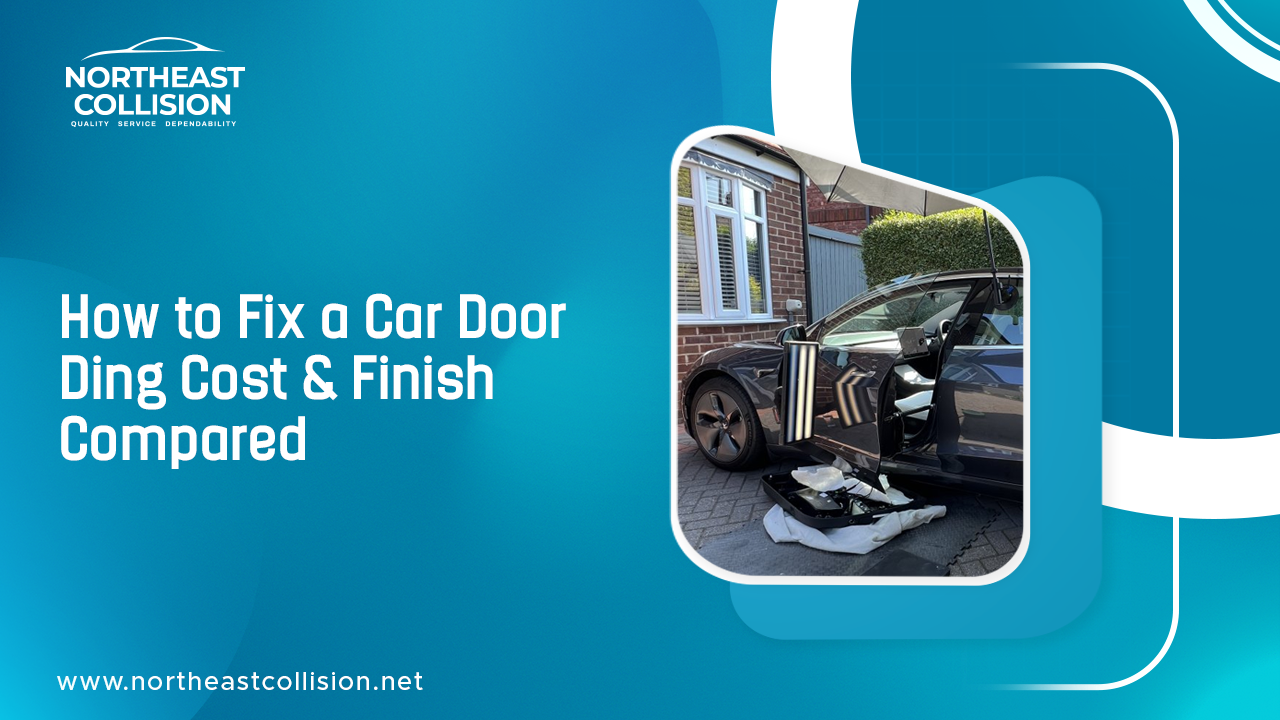
The repair of a door ding can be carried out using a touch-up pen (costing about 10 to 30 dollars), paintless dent repair (between 100 and 300 dollars or more), conventional dent repair (ranging from 300 to 1,000 dollars or so), or by replacing the panel (for 500 to 2,000 dollars or so) according to the extent of the damage. Touch-up is suitable for small paint chips; PDR is appropriate for dents that do not damage the paint and which are accessible; conventional repair applies to cases where the metal or paint is damaged; and replacement is the sensible option when the panel cannot be repaired economically.
These are broad consumer price ranges, not quotes. Labor rates, vehicle model, panel material, paint type, damage size, and location can substantially affect the final price.
The Four Ways a Door Ding Gets Fixed
Even though a dent in a parking lot may seem simple, the most suitable repair will depend on what actually occurred to the door.
The four common routes are:
| Repair route | Typical cost range* | Best suited to | Finish |
| Touch-up pen | 10–30 | Tiny paint chips or scratches | Least seamless |
| Paintless dent repair | 100–300+ | Dents with intact paint | Can preserve factory finish |
| Conventional dent repair | 300–1,000+ | Larger dents or damaged paint | Professional refinished result |
| Door panel replacement | 500–2,000+ | Severe or uneconomical damage | New/replacement panel, refinished as needed |
These figures are general estimates, not guaranteed local prices. The cheapest option is not necessarily the best value. A $15 pen may hide a tiny chip, but it cannot restore a distorted door. At the other end, replacing an entire panel for a shallow dent may be unnecessary.
The goal is to match the repair method to the damage.
Route 1: Touch-Up Pen, and Why It Usually Looks Worse in a Year
Touch-up paint has a narrow but useful purpose: protecting and covering small areas where the paint has been chipped or scratched. It is not a true dent-repair method. If someone opens a door into your car and leaves a tiny paint chip with no meaningful dent, a touch-up product may be enough to improve its appearance and protect the exposed surface.
Route 2: Paintless Dent Repair
Paintless dent repair, or PDR, reshapes the damaged metal without sanding, filling, or repainting the exterior surface, and it is generally the cleanest option for a ding on a parking-lot door because the original factory finish remains intact.
PDR is most appropriate when:
- The original paint is intact.
- The metal has not been severely stretched.
- The dent is relatively shallow.
- There is no major sharp crease.
- The technician can safely reach the back of the damaged area.
I-CAR notes that PDR is used for small, shallow, accessible dents, and OEM repair guidance can specify when PDR is appropriate for particular panels and materials.
Quality PDR involves more than just making the dent go away; according to I-CAR, the procedure can affect the protective coating on the back of a panel, and therefore corrosion protection may need to be restored after the repair.
If you’re searching for car dent repair near me, ask whether the shop evaluates PDR before recommending a painted repair.
Route 3: Conventional Dent Repair and Refinish
PDR stops being the right answer when the metal or paint has gone beyond what can be safely restored while keeping the original finish. That is where conventional car door repair comes in.
The affected area can be reshaped, prepared, and refinished. The repair will depend on the condition of the pane. It may include straightening the metal, filling in low spots where necessary, sanding, applying primer, painting, and blending the finish with that of the adjacent panels.
This method is better suited to damage such as:
- A deep door dent
- A sharp crease
- Torn or cracked metal
- Paint that has been broken through
- Multiple dents close together
- Damage that cannot be reached properly from behind
For instance, the repair information available for Acura indicates that aluminum outer door panels can be repaired if the damage is minor and the repair facility has the necessary tools and expertise. In cases of major damage, replacement will be necessary.
Route 4: Panel Replacement, and When It Is Genuinely Cheaper
It might seem that replacing the door panel is the most costly option—and in many instances, it is. However, there are cases in which repairing a severely damaged panel requires so much labor and involves such extensive refinishing and special work that it makes more sense to replace it.
Replacement may be considered when the panel has:
- Severe deformation
- Extensive creasing
- Torn metal
- Damage that cannot be restored to an acceptable shape
- Material-specific repair limitations
- Damage in an area where the manufacturer does not permit certain repairs
The replacement process isn’t necessarily as simple as bolting on a new piece.
An exterior panel replacement will still need to undergo preparation, painting, blending, have corrosion protection p applied, and be installed correctly. In some cases, the doors also use components that are bonded, welded, or mechanically fastened.
What Each Route Does to Resale Value
There isn’t a simple rule that says PDR increases resale value while conventional repair decreases it. What matters most is the quality and visibility of the repair.
When the PDR repair is carried out properly, it is possible to retain the original factory paint, an important benefit when the paint is not damaged. A door that is professionally refinished can also look very good if the color, texture, panel shape and finish are correctly matched.
No Note on the Windscreen; Is It Worth a Claim?
A parking-lot hit-and-run creates a different question: should you pay for the repair yourself or involve insurance? If you return to your car and find a dent with no note, document everything before moving the vehicle, if practical.
Take clear photographs of:
- The damaged door and surrounding panels
- Paint transfer or marks from the other vehicle
- The wider parking area
- Any debris
- Nearby cameras or signs
- Your vehicle’s position, if relevant
If you have a witness or camera footage, preserve it.
New Jersey provides an SR-1 Self-Reporting Crash form for crashes that were not investigated by police. The insurance implications can depend on the circumstances and your specific policy. New Jersey’s crash-reporting rules also distinguish certain hit-and-run situations when determining an at-fault crash for insurance purposes; the state manual notes that a vehicle struck by a hit-and-run driver is not included in the statutory definition of an at-fault crash when the incident is reported to the proper authorities within 24 hours.
Preventing the Next One
You can’t control how carefully someone else opens a car door, but parking strategy can reduce the odds of damage.
Choose end spaces when practical.
A space next to a curb, island, or other boundary can leave fewer neighboring doors on one side.
Avoid parking extremely close to larger vehicles.
A large SUV or truck can have a wider door swing than you expect.
Look for existing dents before leaving your car.
A quick walk-around gives you a record of the vehicle’s condition.
Park away from the busiest part of the lot when convenient.
A few extra steps of walking can mean fewer cars opening doors beside yours.
Keep documentation.
Photos of your vehicle’s condition can be useful if you discover damage later and need to establish when it occurred.
Frequently Asked Questions
How much does car door dent repair cost?
There is no set price; a minor PDR repair might cost about $100 to $300, while standard repair and refinishing can run several hundred dollars or more. In cases of severe damage requiring panel replacement, the cost can be considerably higher. The final estimate will depend on the type of vehicle, the extent of the damage, the material involved, the paint, access difficulties, and the labor required.
Is paintless dent repair a better option for fixing door dings?
It is a good choice when the paint is still intact and the dent meets PDR requirements, as it preserves the original finish and avoids the need for ordinary painting. However, it isn’t suitable in all cases.
What is the cheapest way to fix a car door dent?
A minor paint chip with no significant dent might be touch-up paint, the most inexpensive option. In contrast, in the real dent where the paint is still intact, PDR could offer a higher-quality repair without incurring the cost of refinishing.
Can a door ding be repaired without painting?
Yes, paintless dent repair is designed to reshape dents that are suitable without keeping the original paint. The technician must first check whether the damage qualifies.
Should I put in a new door after the car was hit in a parking lot?
It is not normally the case with a simple door ding. Replacement of the panel is usually considered the solution when the damage is too severe, the panel cannot be repaired properly, or the manufacturer’s repair requirements make replacement the right choice.
What are the steps I should take after a hit-and-run in a parking lot in New Jersey?
Take photographs of the damage, look for witnesses or camera footage, and report the incident to the relevant authorities when necessary. Before determining how to proceed with the repairs, contact your insurance company to discuss coverage. New Jersey also has an SR-1 form for crashes that qualify and which the police have not investigated.
Would a touch-up pen be sufficient for a scratched car door?
It is suitable for a very minor paint chip or scratch when appearance expectations are low. It cannot fix a dent or match a professional refinish. If the damage is visible and involves a door, it is necessary to have it assessed before attempting a do-it-yourself touch-up.
How do I choose a car dent repair shop near me?
Look for a facility that can explain why your damage qualifies for PDR, conventional repair, or replacement rather than automatically recommending one method. Ask about the technician’s experience with your vehicle’s panel material, the repair process, warranty, and expected finish.