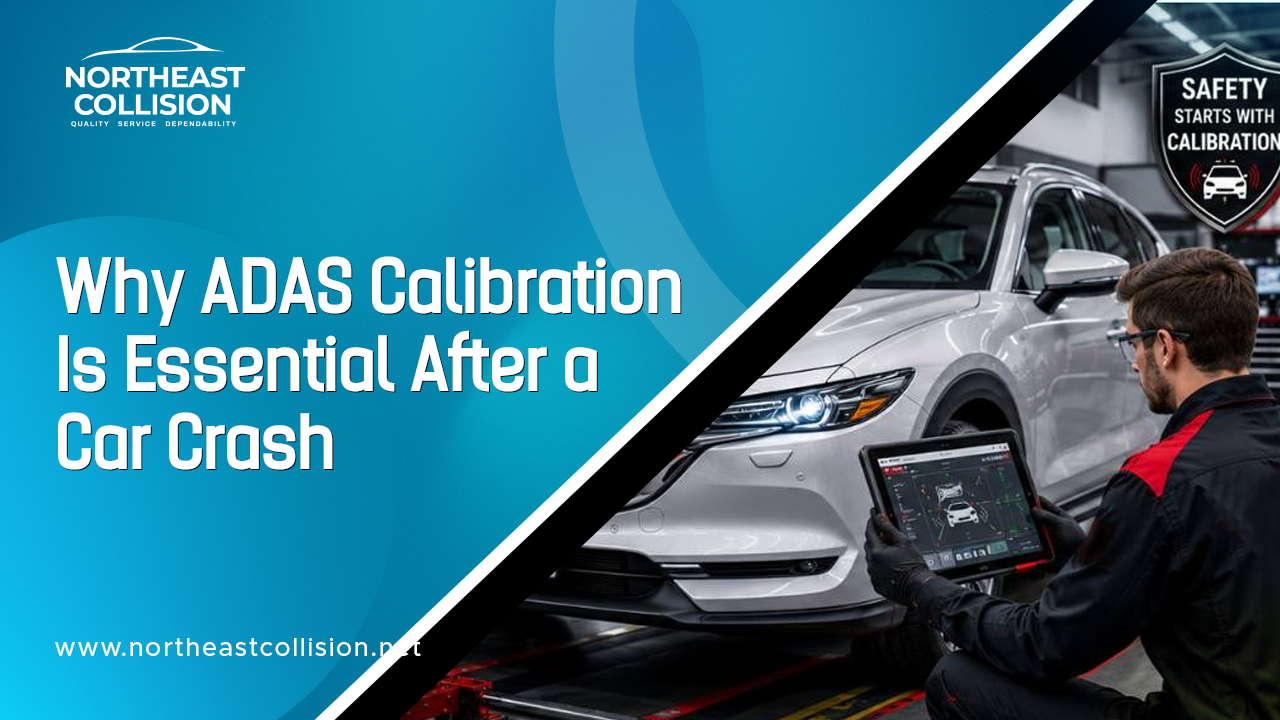
ADAS calibration repositions the cameras, radar, and other sensors used by systems such as lane-keeping, automatic emergency braking, and blind-spot monitoring with high accuracy. It might be necessary following a windscreen replacement, a bumper repair that involves radar or sensors, work on the mirrors, suspension repair, or wheel alignment. The need for it will vary according to the vehicle and the procedure recommended by the original equipment manufacturer.
What ADAS Actually Is on Your Car
ADAS is the acronym for Advanced Driver Assistance Systems; it refers to the set of cameras, radar devices, sensors, control modules, and software that aid a vehicle in detecting its surroundings and assisting the driver.
Depending on the vehicle, ADAS can include:
- Lane departure warning
- Lane keeping assist
- Automatic emergency braking
- Forward collision warning
- Adaptive cruise control
- Blind-spot monitoring
- Rear cross-traffic alert
- Parking assistance
- Surround-view cameras
Vehicle manufacturers employ different hardware arrangements: designers can fit a forward-facing camera behind the windscreen, place radar behind the bumper or grille, put blind-spot sensors in the rear corners, and incorporate parking sensors into the bumper covers.
Why One Degree of Misalignment Matters at 60 MPH
The ADAS sensors don’t just need to be fitted onto the vehicle; they need to be aimed properly.
If a forward-facing camera is slightly off its intended position, the error might appear negligible at short distances. Still, as the distance increases, that small angular deviation can result in a significant shift in the system’s estimate of the position of another vehicle, the lane markings, or the obstacle.
What kinds of repairs result in a requirement for calibration?
There is no universal rule stating that all bumper repairs require ADAS calibration or that all windscreen replacements do.
The requirement is vehicle-specific.
The calibration requirements listed in I-CAR’s OEM calibration database vary by year, make, model, system, and repair type. OEM procedures specify when you must calibrate a camera or sensor after removing, replacing, or disturbing the unit during a repair.
Common repair situations that may trigger calibration or a related system check include:
Windshield replacement
In many cars, there is a forward-facing camera located behind the windscreen. Replacing or removing the glass may affect the camera’s position relative to the vehicle.
The I-CAR states that the requirements set out by the original equipment manufacturer may call for calibration after the windscreen is replaced, after the camera has been removed or replaced, or following any other work that affects the camera’s position.
Bumper repair or replacement
Should the radar or parking sensors be fitted behind or as part of the bumper, removing, replacing, loosening, or damaging the bumper could affect them.
Certain systems call for calibration, while others may need a system test, an initialization, or an aiming procedure. I-CAR, in particular, notes that park-assist sensors may require a bumper cover when removed and must be reset after an impact near the sensor.
If you’re asking whether you need to have the ADAS calibrated after repairing the bumper, the right answer is to consult the repair procedure specific to your vehicle.
Mirror replacement or repair
The side mirrors of a vehicle may contain cameras or other components associated with blind-spot detection. If such a camera or sensor is disturbed, the system may require calibration or initialization.
Suspension work
The ride height and suspension geometry can influence the position and orientation of the sensors relative to the road.
I-CAR refers to Ford’s procedures, which may require the lane-keeping camera to be aligned after a suspension repair or alignment, and so on.
Wheel alignment
Wheel alignment is closely connected to ADAS, as some of these systems rely on the vehicle’s direction and geometry for operation.
According to I-CAR documentation on Audi procedures, you must set the correct thrust angle before performing certain calibration procedures. At the same time, some repairs call for a full alignment, whereas others require only a specified alignment check.
Static Calibration: Targets, Level Floor, Controlled Lighting
The static calibration is carried out at the repair shop. Rather than relying on the vehicle to determine the sensor positions while it is being driven, the technician uses a controlled setup to position both the vehicle and the calibration equipment in accordance with the manufacturer’s specifications.
Depending on the system, this can involve:
- Calibration targets
- Specialized aiming equipment
- Precise measurements
- A level floor
- Correct vehicle ride height
- Proper tire pressure
- Specified lighting or environmental conditions
- A compatible diagnostic scan tool
Dynamic Calibration: The Road Drive and Its Conditions
Dynamic calibration is performed when the vehicle is driven under specific conditions; rather than using a stationary target, the camera or sensor on the vehicle learns or verifies its operating parameters during a controlled road test. Although this might appear easier than static calibration, that need not be the case.
The manufacturer may specify:
- A particular road type
- Minimum or maximum speed
- Clearly visible lane markings
- Suitable weather
- Adequate lighting
- Limited traffic
- A certain driving distance
- Specific steering or vehicle conditions
Calibration of the system will not be completed unless those conditions are fulfilled. For some vehicles, both static and dynamic procedures are necessary. Driving the car around the block does not prove that anyone actually calibrated the ADAS system. The appropriate question to ask is whether the required procedure specified by the original equipment manufacturer was carried out successfully.
Pre-Repair and Post-Repair Scan Reports, and What to Ask For
Calibration is just one element of a full ADAS repair.
A suitable procedure may start with a pre-repair scan.
The scan can detect diagnostic trouble codes (DTCs), record any existing electronic faults, and help determine which ADAS systems are present and may be affected. As part of the I-CAR collision repair diagnostic procedure, it is recommended that you note the warning messages and ADAS systems, identify any calibration requirements, and carry out a pre-repair scan whenever this is possible.
What Takes Place When a Shop Omits It?
The main problem isn’t always a prompt on the dashboard; a car can appear entirely normal after a repair to the bumper or windscreen, even while an ADAS camera or radar sensor is still misaligned.
Depending on the system and the nature of the error, possible consequences include:
- Lane-assist intervention occurring incorrectly.
- Lane markings being detected inaccurately
- Forward warnings occurring at the wrong time.
- Automatic braking functions being affected
- Adaptive cruise control behaving unexpectedly.
- Blind-spot monitoring providing inaccurate information
- A system becoming unavailable when the driver expects it to work.
Calibration is not about making a vehicle “more advanced”; it is about getting the system back to the conditions under which the manufacturer intended it to operate. Clear dashboards can be misleading; the absence of a warning light doesn’t prove you didn’t need a calibration or that a technician correctly verified the system.
Which is why the scanning and calibration records obtained after the repair are valuable following collision work.
Why Not Every Shop Can Perform Calibration
ADAS calibration is not just another case of using a diagnostic scanner.
The equipment, procedures, and requirements vary from one manufacturer to another. As I-CAR points out, calibration tools can be specific to the original equipment manufacturer, and correct calibration requires access to the manufacturer’s repair information. Moreover, certain procedures require special tools, targets, scan tools, or a controlled work area.
A facility may therefore:
- Perform the required calibration in-house.
- Have the equipment but subcontract certain procedures.
- Send the vehicle to another qualified facility for calibration.
No such arrangement is in itself a problem. What is important is whether the necessary procedure is actually carried out correctly and is recorded. If you are comparing collision repair shops, don’t merely ask, “Do you do ADAS?”
Ask:
- Do you identify ADAS systems during the estimate?
- Do you perform a pre-repair scan?
- Do you check OEM calibration requirements?
- Can you perform required static and dynamic procedures?
- Do you verify wheel alignment when required?
- Do you perform a post-repair scan?
- Can you share the calibration results or any documentation?
A shop that can provide clear answers offers you far more useful information than one that merely advertises “ADAS calibration.”
Frequently Asked Questions
Is ADAS calibration necessary after carrying out a bumper repair?
Maybe. It depends on your vehicle, the sensors involved, and what was done to the bumper. Radar, parking sensors, cameras, and their mounting points can have specific OEM requirements after removal, replacement, adjustment, or impact. Check the repair procedure for your exact year, make, and model.
Does replacing the windscreen require ADAS calibration?
Vehicles with forward-facing cameras mounted on their windshields may need calibration after a windscreen replacement or any camera-related work. The specific requirements differ from vehicle to vehicle and depending on the manufacturer.
What is the difference between static and dynamic calibration?
Static calibration involves setting up in a workshop environment, usually using targets and accurate measurements. In contrast, dynamic calibration involves driving on the road so that the vehicle can perform the learning or verification procedure. Some vehicles require static calibration, while others require both static and dynamic calibration.
Does wheel alignment affect ADAS calibration?
They can do so; certain manufacturers insist on performing an alignment or providing a specific alignment check before calibration, since the sensor’s aiming depends on the vehicle’s geometry and the direction in which it is traveling. This requirement varies from vehicle to vehicle.
Does a scan performed after a repair replace ADAS calibration?
Not at all. While a scan can detect diagnostic trouble codes and assist in confirming the system’s status, it will not automatically take the place of a necessary calibration, aiming, ng or initialization procedure. According to I-CAR, the recommended procedure for collision repair involves scanning as part of a more comprehensive diagnostic and calibration process.
Do blind-spot sensors need to have their calibration adjusted following a collision?
Yes, depending on the vehicle and the extent of the damage, a collision involving the rear bumper, sensor, mounting area, or related components will require technicians to perform a manufacturer-specific calibration, initialization, or system test.
How can I tell whether my car needs ADAS calibration after collision repair?
Request that the repair center check the original equipment manufacturer’s guidelines for repair and calibration for your particular vehicle. Do not base your actions solely on whether a warning light is on; the repair operation itself might require a necessary procedure even if the dashboard appears normal.
Should I go for a collision shop that provides ADAS calibration?
It’s worth asking how the shop handles it. A capable collision facility should be able to identify ADAS systems, check manufacturer requirements, complete or arrange required calibration, and verify the vehicle afterward. Access to the right OEM information, tools, and procedures matters more than simply listing “ADAS calibration” as a service.