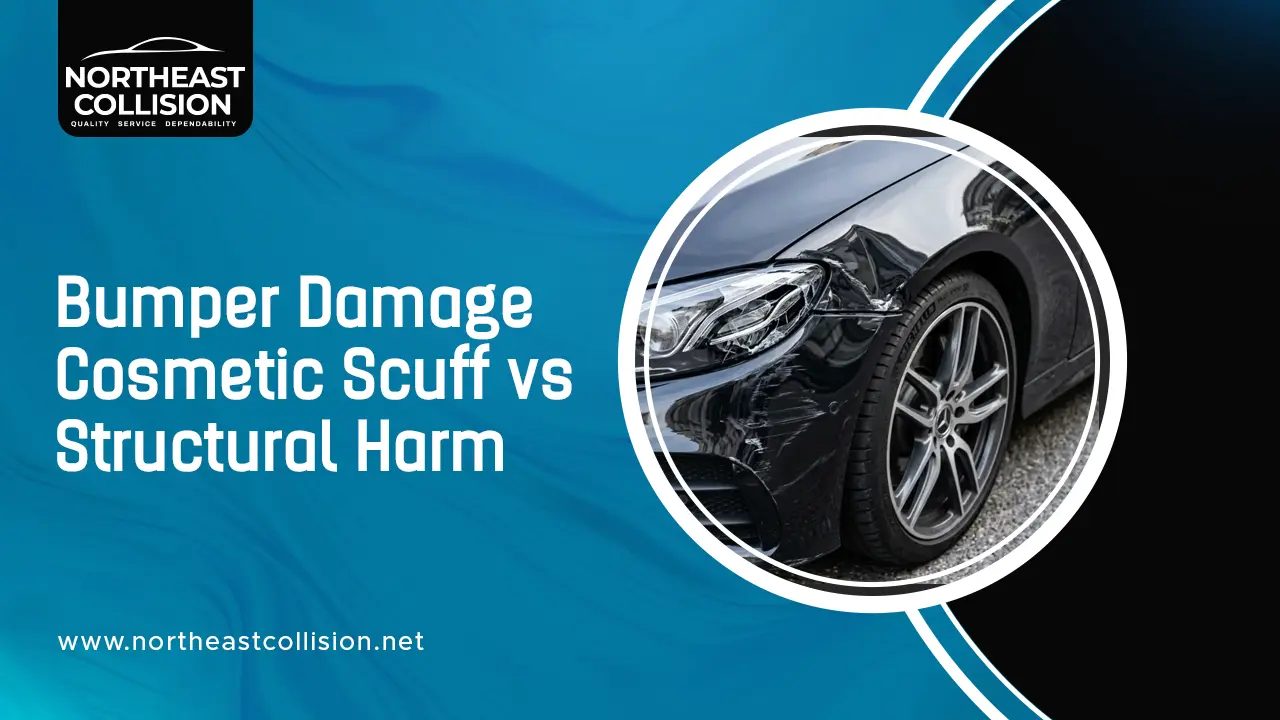
Quick answer: Bumper damage from a car accident is usually cosmetic when only the outer plastic cover is scuffed or scratched and everything else is normal: the bumper sits evenly, the gaps to the fenders, lights and trunk look the same on both sides, no warning lights are on, and the parking sensors work. It needs a professional inspection when the cover is cracked, loose, pushed in or out of line, or when sensors, lights, the hood, the trunk or nearby panels are affected, because the energy absorber, reinforcement bar or mounting brackets behind the cover may be damaged.
A bumper can look surprisingly normal after a collision. The plastic cover is designed to flex, so it often springs back close to its original shape while the parts behind it take the hit. That is why a small scrape after a parking-lot bump and a “clean-looking” bumper after a harder impact can need very different repairs.
This guide explains what sits behind your bumper cover, gives you five checks you can do yourself, and shows how a shop decides whether bumper damage is cosmetic or something more serious.
In this guide:
- What Counts as Bumper Damage After a Car Accident?
- What Is the Bumper Cover Called, and What Sits Behind It?
- How to Tell If Your Bumper Is Damaged: 5 Checks
- What Causes Hidden Bumper Damage?
- Cracked Bumper: Can It Be Repaired or Does It Need Replacing?
- How a Body Shop Assesses Bumper Damage
- What to Do If Your Bumper Is Damaged in an Accident
- How Long Bumper Repairs Take and What Affects the Cost
- Bumper Damage Inspection at Northeast Collision in Plainfield, NJ
- Frequently Asked Questions
What Counts as Bumper Damage After a Car Accident?
Bumper damage ranges from a paint scuff to hidden structural damage. The table below shows common signs and what they usually point to. It is a general guide, not a diagnosis.
| What You Notice | Usually Cosmetic or Needs Inspection? | Likely Next Step |
| Light scuff or paint transfer, bumper sits normally | Usually cosmetic | Cosmetic repair or refinishing |
| Scratch through the paint into the plastic | Usually cosmetic | Plastic repair and refinishing |
| Dent or crease in the cover | Needs inspection | Check mounting points and parts behind the cover |
| Spider cracks, hairline cracks, or a split | Needs inspection | Repair or replacement, depending on size, location and manufacturer rules |
| Bumper loose, sagging, or popping out at a corner | Needs inspection | Check clips, tabs and brackets before driving long distances |
| Uneven gaps at the fender, headlight, taillight or trunk | Needs inspection | Check brackets, reinforcement and nearby panels |
| Parking sensor fault or driver-assistance warning | Needs inspection | Scan, test and possibly calibrate sensors |
| Trunk, hood or liftgate no longer closes normally | Needs inspection | Check for damage beyond the bumper |
What Is the Bumper Cover Called, and What Sits Behind It?
The painted plastic part you see is the bumper cover, also called the bumper fascia. It is only the outer layer of the bumper assembly. Depending on the vehicle, behind it you may find:
- An energy absorber, usually foam or plastic, designed to soak up energy in a low-speed impact.
- A reinforcement bar (sometimes called the bumper beam), usually steel or aluminum, which spreads impact forces into the vehicle’s structure.
- Brackets, clips and mounting tabs that hold the cover in position.
- Wiring and parking sensors, often mounted directly in the cover.
- Radar sensors for blind-spot monitoring, rear cross-traffic alert, or adaptive cruise control on some vehicles.
Because the cover flexes and can spring back, the energy absorber, reinforcement or brackets can be damaged even when the outside looks almost normal. So when you are judging bumper damage, do not judge it only by the scratch you can see.
How to Tell If Your Bumper Is Damaged: 5 Checks
These five checks can help you decide whether your bumper needs professional attention. They do not replace an inspection, but they will tell you when guessing from the outside is not enough.
Check 1: Panel Gaps at the Fender and Headlight Seams
Stand a few feet back and look at where the bumper meets the fenders, headlights, grille or trunk. The gaps should look about the same on both sides. A bumper that sits lower, sticks out, or leaves an unusually wide gap may have broken clips, damaged brackets, or shifted mounting points.
After a rear impact, pay close attention to the corners near the rear quarter panels. If one side sits flush and the other looks pulled away, that is more concerning than an isolated paint scuff. Damage that reaches the panel itself may need quarter panel repair as well as bumper work.
Check 2: Warning Lights and Driver-Assistance Features
Many bumpers house ultrasonic parking sensors, and some vehicles have radar sensors behind the cover for blind-spot monitoring or rear cross-traffic alert. After a collision, check whether:
- A parking sensor stops detecting nearby objects or beeps constantly.
- Blind-spot monitoring or rear cross-traffic alert stops working.
- A warning message appears on the instrument cluster.
- A driver-assistance feature becomes unavailable.
A warning light is not the only reason to get the car checked. Some systems need a scan, functional test, or calibration after an impact or after the bumper is removed, even when no warning appears. Our guide to ADAS calibration after collision repair explains why.
Check 3: How the Cover Sits at the Wheel Arch
Look where the bumper meets the wheel opening. The edge should follow the curve of the wheel arch without looking stretched, bowed, or detached. Signs of trouble include:
- A loose corner, or a section that moves when you press it gently.
- Broken or missing clips.
- A bumper edge sitting higher or lower than the panel next to it.
- A gap between the bumper and the wheel-well liner.
Sometimes the plastic cover is fine but the attachment points are broken. Technicians can often rebuild damaged plastic mounting tabs instead of replacing the whole cover; 3M’s plastic tab repair procedure is one example of how this is done. If the bumper keeps popping out after you push it back in, treat it as more than a cosmetic issue.
Check 4: Paint Crazing, Stress Marks and Hairline Cracks
A surface scuff is one thing. Cracking is another. Look at the damaged area in good light for:
- Scratches in the paint only.
- Deeper gouges into the plastic.
- Spider-web cracking or paint crazing around the impact point.
- A split or tear through the plastic.
- Distortion or a crease around the impact.
Minor surface damage can often be fixed with cosmetic repair and refinishing, and shallow scratches may only need car paint scratch repair. Cracks that go all the way through the plastic need a different repair method, and some cannot be repaired at all, as explained below.
Check 5: Trunk, Hood and Door Alignment
A bumper impact is not always limited to the bumper. After a rear hit, check that the trunk or liftgate opens, closes and latches normally, and compare the gaps around it side to side. After a front hit, check the hood, headlights and fenders.
Watch for:
- A trunk or liftgate that needs extra force to close, or a latch that does not catch.
- A hood that sits unevenly.
- A headlight or taillight that has shifted.
- A new gap between panels, or a door that looks out of line after a corner impact.
These signs do not automatically mean the vehicle has structural damage, but they do mean the damage may go beyond the bumper cover. A shop may need to check whether structural damage repair is required.
Hidden damage happens because the bumper assembly is built to absorb and pass on impact energy, not to show it. In a collision:
- The flexible cover bends and then springs back, hiding what happened behind it.
- The energy absorber can crush, crack, or compress and stay that way.
- Plastic clips and tabs can snap without leaving visible marks on the outside.
- The reinforcement bar and its mounts can bend and pass force into the frame rails, radiator support, or the rear body panel and trunk floor.
- Sensors and their brackets can shift out of position, which affects how they read the road.
This is why even a low-speed impact can leave damage that only shows up once the cover is removed.
Cracked Bumper: Can It Be Repaired or Does It Need Replacing?
Many cracked bumper covers can be repaired, but not all. The decision depends on the size and location of the crack, the type of plastic, whether mounting areas are damaged, and what the vehicle manufacturer allows.
Sensors make this decision more important. Some manufacturers restrict plastic repairs, fillers, or paint thickness in the areas around radar and parking sensors, because changing the cover’s shape or coating can affect how the sensors work. For example, I-CAR reports that Mercedes-Benz does not allow filler repairs in the sensor area of the bumper and limits paint build-up over short-range radar sensors, and that the bumper must be stripped or replaced if the radar does not work correctly after painting (I-CAR).
So “repair or replace?” should not be decided on price alone. Our full guide to bumper repair vs. replacement walks through the common scenarios.
How a Body Shop Assesses Bumper Damage
A proper assessment starts with inspection, not with sanding and painting the visible damage. A typical process looks like this:
- Visual check: the technician looks at the cover, gaps, lights, and nearby panels on both sides of the vehicle.
- Scan: a pre-repair diagnostic scan checks for stored fault codes from sensors and driver-assistance systems.
- Teardown: the bumper cover is removed so the energy absorber, reinforcement bar, brackets, and sensor mounts can be inspected.
- Repair procedures: the technician checks the manufacturer’s repair information for what can be repaired and what must be replaced, especially around sensors.
- Measurement if needed: if mounting points or rails look out of position, the structure is measured against factory specifications.
- Estimate: the repair plan and estimate are written, and updated with a supplement if more damage is found.
- Final checks: after the repair, sensors are tested or calibrated as required, and a post collision inspection confirms everything works and fits correctly.
What to Do If Your Bumper Is Damaged in an Accident
- Make sure everyone is safe, then take photos of the bumper, the gaps around it, and the scene before the car is moved, if it is safe to do so.
- Check whether the bumper is loose, dragging, or blocking lights. If it is, do not drive the car any distance; arrange towing instead.
- Note any warning lights or sensor messages on the dashboard.
- Report the accident to your insurer as soon as reasonably possible. Our guide on what to do after a car accident in New Jersey covers the first 24 hours.
- Get the bumper inspected before you decide how to pay. If you are unsure whether to claim, read our guide to filing a claim or paying out of pocket in New Jersey.
How Long Bumper Repairs Take and What Affects the Cost
A bumper that only needs cosmetic work can often be repaired in 1 to 2 days. A bumper cover that needs replacement, paint matching and blending usually takes about 3 to 5 days, and longer if parts must be ordered or sensors need calibration. Our guide to how long collision repair takes explains the full timeline.
Cost depends on whether the cover can be repaired, the parts behind it, paint and blending, and any sensor work. Our collision repair cost guide explains what moves the price. Your actual cost and timeline are confirmed only after an inspection.
Bumper Damage Inspection at Northeast Collision in Plainfield, NJ
At Northeast Collision, the question is not only whether a bumper can be made to look new. It is whether the bumper and the parts around it can be restored to meet the vehicle’s repair requirements. Our bumper collision repair starts with a full inspection, including the parts behind the cover and any sensors.
Our technicians are I-CAR Gold Class trained, and our team works directly with most major insurance companies. If the damage goes beyond the bumper, we handle the full accident damage repair, including fender repair and other collision repair work.
Not sure if your bumper damage is cosmetic? Call (908) 226-3566 or book an appointment for an inspection.
Frequently Asked Questions
Is a bumper scuff just cosmetic?
Often, yes. A scuff is usually cosmetic when the damage is limited to the paint or the outer plastic surface and the bumper still sits evenly, with normal gaps and working sensors. A visual check cannot show damage behind the cover, so an inspection is still wise after a harder impact.
How can I tell if my bumper is damaged after an accident?
Check five things: even gaps at the fenders, lights and trunk; no warning lights or sensor faults; a secure fit at the wheel arches; no cracks or paint crazing; and a trunk, hood and doors that open and close normally. If any of these look wrong, have the bumper inspected.
What is the plastic bumper part called?
The painted plastic part is called the bumper cover or bumper fascia. Behind it are usually an energy absorber, a reinforcement bar, mounting brackets and clips, and on many vehicles parking or radar sensors.
What causes hidden damage behind a bumper?
The flexible cover can bend and spring back while the energy absorber crushes, clips or brackets break, or the reinforcement bar bends. Impact force can also travel into the frame rails, radiator support or rear body panel, so damage may only show once the cover is removed.
Can a cracked bumper be repaired?
Some cracks can be repaired, depending on their size and location, the type of plastic, and whether the vehicle manufacturer allows the repair. Cracks that go through the plastic need a different repair than surface cracks, and repairs near sensors may be restricted.
How do I know if my bumper needs repair or replacement?
Replacement may be needed for large tears, severe distortion, extensive cracking, broken mounting areas, damage around sensors, or damage to parts behind the cover. Minor surface damage and some broken tabs can often be repaired, following the manufacturer’s procedures.
Can bumper damage affect parking sensors?
Yes. Parking sensors are often mounted in the bumper cover, and an impact can damage the sensor, its bracket, the wiring, or the area around it. Some vehicles need a system test or calibration after an impact near a sensor or after the bumper is removed.
Is it safe to drive with a loose bumper?
A loose or badly misaligned bumper should be inspected as soon as possible. Broken mounting points can let the bumper drag or come off while driving, and it may be hiding other damage. If it is hanging, dragging, or blocking lights, have the car towed.
Does a bumper need to be replaced after every collision?
No. Bumper covers can often be repaired when the damage is minor and the repair meets the vehicle’s requirements. Replacement is needed when the damage is severe, sits in a restricted sensor area, or extends to the parts underneath.
How long does bumper repair take?
Cosmetic bumper repairs can often be done in 1 to 2 days. A bumper cover replacement with paint matching and blending usually takes about 3 to 5 days, and longer if parts must be ordered or sensors need calibration.
Note on Pricing, Timelines, and Estimates
All repair times, ranges, and examples in this article are general guidance provided for information only. They are not a quote, offer, or guarantee of how long your repair will take or what it will cost.
The actual repair method, timeline and cost for your vehicle depend on its make, model, and year, the bumper material, the type and extent of visible and hidden damage, sensor and calibration requirements, manufacturer repair procedures, parts availability, and insurance approvals.
Your final price and completion date will be confirmed only in a written estimate after our technicians complete a full inspection of your vehicle. If additional damage is found once work begins, we will contact you, and your insurer where applicable, before any additional work is done. Insurance coverage is determined by your policy and your insurer.