
You’ve got a dent. Maybe it’s from a shopping cart in a parking lot, maybe it’s hail, maybe someone clipped your door in a tight space. The question that actually matters isn’t “how do I fix this?”, it’s “which fix does this specific dent need?” That answer depends almost entirely on what happened to the metal and the paint underneath, not on how big the dent looks. For more serious cases involving actual collisions rather than dings, that same assessment is what shops rely on to scope out accident damage repair services before quoting any price.
What Is Paintless Dent Repair (PDR)?
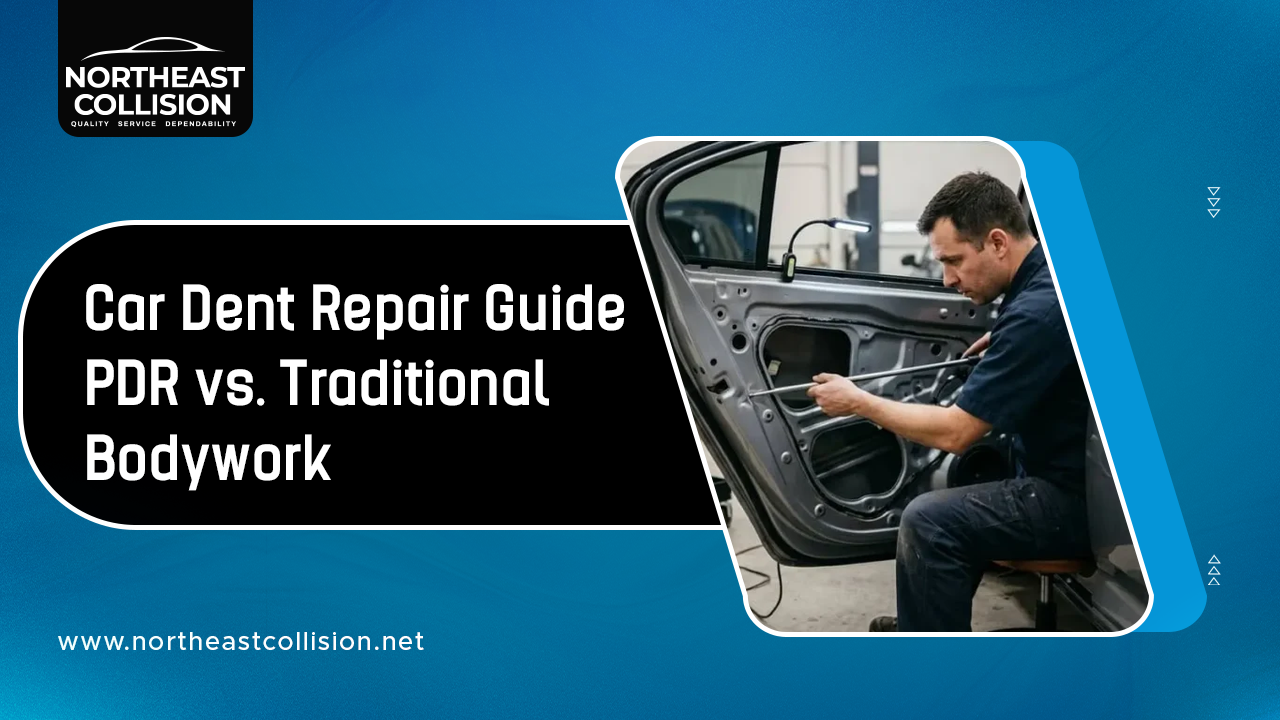
Paintless dent repair is a technique in which a technician massages the metal back into shape from behind the panel, via specialized rods and tools, without touching the paint at all.
No fillers, no sanding, no repainting. The factory finish stays exactly as it was before the dent happened, which is the whole appeal. A skilled PDR technician can work a deep, smooth dent back to nearly invisible in under an hour, often while you wait.
The technique relies on access and leverage. Technicians use a range of specially shaped metal rods, sometimes paired with glue-pull tabs on panels where access from behind is unavailable, to apply gradual pressure to the low points of the dent until the metal returns to its original contour. It’s a skill that takes years to develop — judging exactly how much pressure to apply, and where, without overcorrecting and creating a high spot — which is why PDR quality varies widely among technicians,s even when the equipment looks similar.
What Is Traditional Dent Repair?
Traditional dent repair fixes the dent and then rebuilds the surface: the technician hammers or pulls the metal into rough shape, fills any remaining low spots with body filler, sands the area smooth, primes it, and repaints and blends the panel to match the surrounding color.
It’s a more involved process because it’s solving a different problem, not just shape, but a damaged paint surface that can’t be left as-is. When the damage originated from an actual impact with another vehicle rather than a stray shopping cart, this is often where auto collision repair services pick up, since the underlying issue is the same: metal and paint that need full reconstruction, not a massage.
This approach is also the only option when the metal itself has stretched. Once metal stretches past a certain point, it physically can’t be pushed back to its exact original contour — there’s excess material that needs to be handled with filler to restore a smooth, level surface. That’s a metallurgy limit, not a skill limit, which is why even the best PDR technician in the state can’t talk a stretched panel back into shape.
PDR vs. Traditional Dent Repair: Side-by-Side
| Factor | Paintless Dent Repair | Traditional Dent Repair |
| Cost | $75 – $150 per small dent; $300 – $600 for larger hail-style damage | $300 – $1,500+ depending on panel size and paint work |
| Time | 30 minutes – 2 hours, often same-day | 1 – 5 days, depending on paint curing time |
| Paint involved | None — original factory paint preserved | Yes — filler, primer, paint, and color-matched blend |
| Durability | Excellent — no seams, no risk of future peeling or mismatch | Good, but repainted areas can age differently from factory paint over the years |
| Best for | Shallow dents, dings, hail damage, dents with intact paint | Creased dents, cracked or chipped paint, dents near panel edges |
When PDR Is the Right Call
PDR works when the metal is dented,d but the paint’s surface integrity is still intact — meaning it didn’t stretch, crack, or chip when the dent happened. That’s the deciding factor, not the size of the dent.
Good candidates for PDR include:
- Hail damage: Usually a cluster of shallow, rounded dents across a hood, roof, or trunk, with paint that’s still fully intact.
- Door dings: The classic parking-lot dent from another car’s door, often a clean, shallow impression.
- Shopping cart dent: Similarly shallow, with no scraped paint at the point of impact.
- Minor hood or fender dings: From light contact that didn’t crease the metal.
If you run your hand over the dent and the paint feels smooth, unbroken, and corresponds to the rest of the panel, there’s a real chance PDR can fix it without any paint work at all.
When Conventional Repair Is Necessary
Conventional auto body repair becomes necessary the moment the paint’s structural strength is compromised, or the metal has deformed in a way that PDR tools can’t reach or correct.
That includes:
- Creased dents — a dent with a sharp fold or line, rather than a smooth, rounded depression. The metal has stretched at the crease, and that stretch can’t be massaged back to its original shape. Deeper creases like this sometimes cross over into structural damage repair services, especially if the fold runs into a support panel rather than just cosmetic sheet metal.
- Cracked or chipped paint — once paint has broken at the impact point, there’s no way to push the metal back without leaving visible cracking or flaking. The surface has to be redone.
- Dents near panel edges — edges, seams, and areas close to body lines often don’t have enough flex or access room for PDR rods to work effectively, and when the damage runs into the chassis itself, it’s a job for auto frame repair services rather than dent work of any kind.
- Damage with scraping or scratching — if the impact gouged the clear coat or base layer, that’s a paint problem on top of a metal problem, and only traditional repair addresses both. This is common with lower-panel impacts, which is also where bumper collision repair services typically come in, since bumpers absorb the brunt of low-speed contact.
A technician will typically check the dent’s depth, the condition of the paint right at the point of impact, and how close it sits to an edge or body line before recommending either approach.
Finding the Right Shop, Not Just the Closest One
A search for “dent repair near me” will turn up a long list of options, but PDR and traditional repair require different things from a shop, and not every place that advertises one actually does both well.
For PDR specifically, experience matters more than equipment. The rods and tools are widely available, but the technique itself is almost entirely about the hands using them. Ask how long the shop has been doing paintless repair specifically, and ask to see examples of completed work on a panel similar to yours. A hood versus a roof can require different access and techniques.
For traditional repair, the question to ask is about paint matching. Factory paint has subtle variations by production batch, and a shop with a good color-matching process (and the patience to test a blend before committing to the full panel) will produce a repair that’s invisible. A rushed color match is one of the most common reasons traditional repairs look slightly “off” years later, even when the bodywork underneath was done correctly.
A shop that offers both services under one roof has an advantage here: there’s no incentive to push you toward the more expensive option just because that’s the only thing they do, and you’ll get a straight answer about which your specific dent actually needs. It also means that if a minor ding turns out to be part of something bigger, they can move straight into post-collision repair services without sending you somewhere else for a second opinion.
Realistic Cost and Time Ranges
Paintless dent repair costs for a single small ding usually range from $75 to $150. Larger dents, or hail damage covering multiple panels, can run $300 to $600 or more, since pricing is typically based on the number and size of dents rather than a flat rate. Most jobs are completed the same day, and many smaller repairs take well under an hour.
Traditional dent repair starts around $300 for a small panel with minor paintwork and can climb past $1,500 for larger panels calling for extensive filler, primer, and a full paint blend into adjacent panels. Turnaround is typically one to five business days, mainly because paint needs proper curing time between coats; rushing this step is how mismatched color and uneven texture happen.
The price gap between the two methods is one of the main reasons to get an actual assessment before assuming you need a full repaint. A dent that looks severe can sometimes still qualify for PDR if the paint held up, and that difference can mean paying $100 instead of $800.
A few factors shift the price within each category, too. For PDR, location on the panel matters as much as size; a dent in the middle of a door is usually easier to access from behind than one near a body line or close to a window frame, where rods have less room to maneuver. For traditional repair, the biggest swing factor is how many panels need to be blended to hide the new paint. A single isolated panel is far cheaper than a repair that has to blend into two or three adjacent panels to avoid a visible line where old and new paint meet.
Verdict: How to Know Which One Your Car Needs
There’s no universal rule that works from a photo or a guess; the paint condition right at the point of impact is what decides it, and that’s genuinely hard to assess without someone passing a hand over it and checking the metal underneath.
The fastest way to find out is a free, no-obligation assessment. A trained eye can usually tell within a couple of minutes whether your dent is a PDR candidate or needs the traditional route, and you’ll walk away with an honest answer and a real price, not a guess based on how the dent looks from across the parking lot.
If you’ve got a dent and you’re not sure which category it falls into, bring it in and get it looked at before you assume either way.
Frequently Asked Questions
Is paintless dent repair worth it?
Yes, when the dent qualifies. PDR preserves your car’s original factory paint, costs significantly less than traditional repair, and is usually completed the same day. The only downside is that it doesn’t work on every dent, paint damage, or sharp crease; it rules them out regardless of how minor the dent looks.
How much does paintless dent repair cost?
Most single dents run $75 to $150, while larger or multiple dents, like hail damage across several panels, typically cost $300 to $600. Final pricing depends on the number of dents, their size, and their accessibility from behind the panel.
Can any dent be fixed with PDR?
No. PDR only works when the paint’s surface is still intact, and the metal hasn’t creased or stretched sharply. Dents with cracked paint, scraping, or sharp folds need traditional repair, since the paint surface itself has to be rebuilt, not just the shape underneath it.
Does PDR damage the original paint?
No. That’s the core benefit of the technique. Because the technician works on the metal from behind the panel without sanding, filling, or repainting, the factory factory paint remains completely untouched, so the panel keeps its factory finish and color match exactly as before the dent.