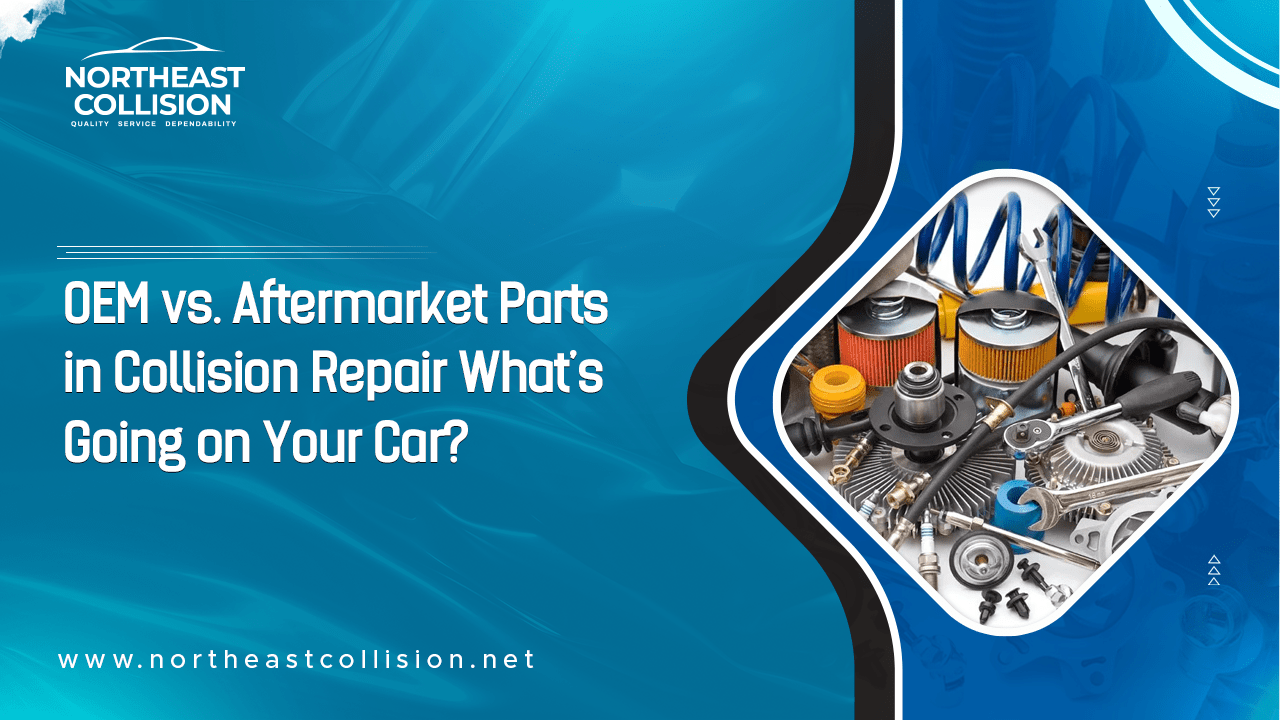
When your car needs collision services, one of the most important choices comes before any work begins: deciding which parts will be used. Knowing the difference between OEM and aftermarket parts lets you talk confidently with your repair shop and insurance company. It also helps you avoid just going along with whatever is listed in the estimate. Make sure to ask which parts are being used and why.
OEM Parts
OEM means Original Equipment Manufacturer. These parts are made by or for your car’s maker and match the exact specifications, materials, and standards as the original parts. For example, if you need a new bumper for a Honda, an OEM part is made to Honda’s design and quality, often by the same company that made the original.
Aftermarket Parts
Aftermarket parts are made by companies other than your car’s manufacturer. They are designed to fit and work like OEM parts, but their quality can vary a lot. Some are certified to high standards, while others are cheaper and may not be tested as carefully.
Neither OEM nor aftermarket parts are always better. The best choice depends on the part, your car, your insurance, and whether the repair affects safety or structure. The next sections explain how they compare.
OEM vs. Aftermarket: Side-by-Side Comparison
| Factor | OEM Parts | Aftermarket Parts |
| Fit | Designed to exact factory tolerances; consistent panel gaps and alignment | Varies by manufacturer; certified aftermarket parts fit well, budget parts may require adjustment |
| Safety | Matches original crash-test engineering and material specs | Varies; independently certified parts can perform comparably, uncertified parts may not |
| Quality | Consistent, manufacturer-controlled materials and manufacturing process | Ranges widely, from certified, high-quality options to inconsistent budget parts |
| Cost | Generally, a higher upfront cost | Generally lower upfront cost, sometimes significantly |
| Warranty | Typically backed by the vehicle manufacturer’s warranty | Varies by manufacturer; certified aftermarket parts often carry their own warranty |
| Insurance Coverage | May require the policyholder to request it, sometimes at an added cost | Frequently, the default in many insurance repair estimates |
This table is a useful starting point, but the real-world answer for your specific repair depends heavily on which part is involved. A cosmetic trim clip and a structural bumper reinforcement bar carry very different stakes. Use it to guide your questions about each part.
How Insurers Decide Which Parts to Pay For
Insurance companies write collision repair estimates based on cost, part availability, and, increasingly, independent quality checks for aftermarket components.
Cost Is a Major Factor
Aftermarket parts usually cost less than OEM parts, so insurers often choose them to keep claim costs down. This is not always a problem—many non-structural, exterior parts work just fine as quality aftermarket parts. Still, the default estimate may not be the best choice for every part on your car.
Certification Standards Matter
Good aftermarket parts are often certified by independent groups that check how they fit, their material quality, and how well they resist rust. Insurers often look at these certifications when deciding if they should use an aftermarket part, since certified parts have a proven record.
State Regulations Play a Role
Many states require insurers or repair shops to tell customers when non-OEM parts are used in an estimate. This way, you know what’s being used and can ask questions or request changes, instead of having parts switched without your knowledge.
Your Policy Language Matters
Some insurance policies prefer aftermarket parts to help keep your premiums lower, while others use OEM parts, especially for newer cars still under warranty. Check your policy or ask your agent so you know what you’re entitled to before you need to file a claim.
Your Right to Request OEM Parts (and When It Costs Extra)
Many drivers don’t know this, but in most cases, you can ask for OEM parts for your repair, even if the insurance estimate uses aftermarket parts. If you prefer OEM, just ask for them directly.
When OEM Is Typically Provided at No Extra Cost
- Your vehicle is still within its original manufacturer’s warranty period. In that case, many insurers will use OEM parts specifically to preserve that warranty coverage.
- Your policy specifically includes OEM parts coverage (sometimes offered as an endorsement or add-on).
- Certain structural or safety components may only be available or approved in OEM form, in which case there’s no aftermarket alternative to consider.
When Requesting OEM Parts May Cost You Extra
If your policy doesn’t cover OEM parts and your car is out of warranty, you might have to pay the difference if you want OEM instead of aftermarket parts. This isn’t always the case—it depends on your policy and insurer. It’s a good idea to ask about this before repairs start.
How to Ask
Usually, all you need is a straightforward talk with your insurance adjuster or the auto body repair shop’s estimator. Ask which parts on your estimate are OEM and which are aftermarket, and what it would cost to switch to OEM. Go over each item together so everything is clear.
Why Certified Repairs Often Require OEM Parts and Procedures
Vehicle manufacturers increasingly certify collision repair shops to work on their specific brands. These certification programs typically come with strict requirements, including, in many cases, mandatory use of OEM parts for certain repairs.
Structural and Safety-System Integrity
Modern cars are designed as complete systems. Features like crumple zones, steel reinforcements, sensors, and airbag timing are all set up to match the exact materials and sizes of OEM parts. Manufacturers often require OEM parts for these areas because using something different could affect how your car performs in a crash.
Calibration Requirements
Cars with driver-assist features like lane departure warning, emergency braking, and adaptive cruise control use cameras and sensors that need to be recalibrated after some repairs. Manufacturers often require OEM parts and exact procedures for this, since accurate calibration depends on using parts that match the originals.
Warranty Preservation
If non-approved parts or methods are used for some repairs, the manufacturer might not honor related warranty claims later. Certified shops use OEM repair procedures to help keep your warranty coverage.
The Bottom Line on Certified Repairs
A certified auto body shop doesn’t choose OEM parts at random. They follow the procedures set by your car’s engineers. For structural repairs, safety systems, and driver-assist features, using OEM parts is usually required by the certification.
What Northeast Collision Recommends, and Why
Based on all this, the best approach is to consider each repair on a case-by-case basis. This is what Northeast Collision recommend to our customers:
- For structural and safety-critical parts, like frame sections, reinforcement bars, airbag parts, and anything needing driver-assist calibration, OEM parts and manufacturer procedures are the best choice. These repairs have the highest stakes and the least room for error.
- For many cosmetic and exterior parts, like some bumper covers, trim, and non-structural panels, certified, high-quality aftermarket parts can be a good and affordable choice. Just make sure they meet independent quality standards.
- Always know what’s on your estimate. Whichever direction a repair goes, ask for a clear, itemized explanation of which parts are OEM and which are aftermarket, along with the reasoning behind each choice.
- Ask questions before you sign anything. If you’re not sure about a part, ask your estimator to explain the pros and cons in simple terms. A good shop will answer your questions clearly instead of avoiding them.
The goal isn’t to default to one category across the board. It’s to match the right part to the right repair, based on safety requirements, manufacturer guidelines, and what actually makes sense for your specific vehicle.
Frequently Asked Questions
Are aftermarket parts safe for collision repair?
It depends on the part and its certification. Many aftermarket components, particularly those independently certified for fit and quality, perform well in non-structural applications. However, structural and safety-critical parts are generally best sourced as OEM, since they’re engineered and tested as part of the vehicle’s overall crash-safety system.
Can I request OEM parts from my insurer?
In most cases, yes. Whether it comes at additional cost depends on your specific policy, your vehicle’s warranty status, and your insurer’s parts guidelines. It’s worth asking your adjuster directly what your policy covers before repairs begin.
Do aftermarket parts affect resale value?
They can, especially if buyers or appraisers ask about your car’s repair history and which parts were used. Using certified aftermarket parts is usually not a problem if you have records, but low-quality or undocumented parts can be. Keeping good repair records helps no matter which parts you use.
Why does my certified repair require OEM parts?
Manufacturer certification programs often require OEM parts and specific procedures for structural repairs and driver-assist systems, because these features are set up to match factory specs. This helps your car perform as designed in a crash and keeps your warranty valid.