There was a time, not too long ago, when a skilled auto body technician only needed a heavy slide hammer, some lead filler, and a good eye to “make it right.” If a door didn’t shut perfectly after an accident, you’d simply give it a little muscle until it clicked into place.
But those days are officially gone. If you attempted that manual approach with a modern electric vehicle (EV) or a high-strength aluminum-bodied truck, you would likely cause far more structural damage than what occurred in the original collision.
Today, a premier auto body shop operates much more like a high-precision laboratory. The advanced collision repair equipment we utilize isn’t a luxury; it is a strict manufacturer requirement. Without it, a shop is essentially guessing at the safety and structural integrity of a machine engineered to carry your family at highway speeds.
The Foundation: Computerized Unibody Frame Measuring
Modern passenger vehicles are built using integrated unibody construction, meaning the vehicle’s exterior panels and underlying frame structure are fused into a single unit. When a vehicle sustains an impact, that kinetic energy travels dynamically through the entire shell. You might see a visible dent in the rear quarter panel, but the structural “twist” or “diamond” could be sitting directly in your front suspension.
To solve this, certified centers rely on digital spatial blueprinting:
| Advanced Equipment | Technical Process | Core Benefit to Vehicle Owner |
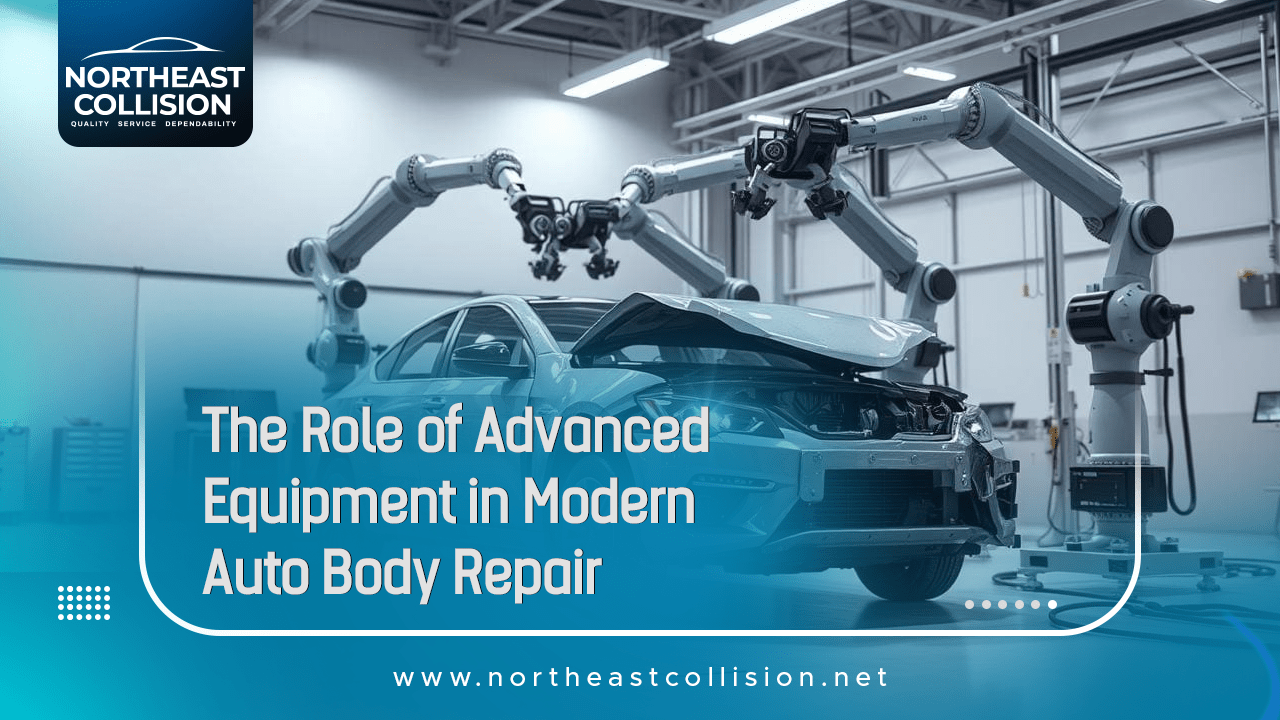
| Laser-Guided Measuring Systems | Computerized arms scan the chassis, mapping coordinates in 3D space against the manufacturer’s original digital blueprints. | Discovers hidden structural shifts invisible to the naked eye. |
| Zero-Tolerance Alignment | Restores the vehicle framework to within a single millimeter of original factory specs. | Prevents “dog-tracking” (driving slightly sideways) and premature tire destruction. |
Welding in the Age of High-Strength Metallurgy
In the past, an auto body technician could utilize a standard MIG welder for almost any structural repair. However, modern automotive engineers now construct vehicle safety cages using Ultra-High-Strength Steel (UHSS) and advanced boron steel alloys—specifically inside the “A” and “B” pillars—to prevent passenger cabin intrusion during a rollover.
If a repair technician applies excessive, uncontrolled heat to these advanced alloys using old-school welding equipment, it permanently alters the steel’s molecular structure. It renders the high-strength safety cage incredibly brittle.
To preserve your protection, Northeast Collision utilizes specialized inverter spot welders. These advanced machines completely mimic the vehicle manufacturer’s original assembly line welds by applying immense hydraulic pressure combined with micro-second, computer-controlled bursts of high-voltage electricity, fusing the metals without altering their engineered strength.
Advanced Automotive Refinishing Technology
Restoring your vehicle’s factory appearance requires a highly controlled chemical environment. True invisible color matching and long-term paint durability rely on three distinct pieces of advanced refinishing technology:
- Down-Draft Heated Spray Booths: Think of these pressurized booths as a clean room for your vehicle. Instead of allowing air to swirl loosely, these booths draw clean, heavily filtered air down from the ceiling straight into the floor vents. This continuous “air curtain” pulls away microscopic dust particles and paint mist before they can settle on your wet clear coat, followed by a high-heat bake cycle to chemically cure the finish into a rock-hard shield.
- Computerized Spectrophotometers: This is the digital eye that completely solves the color-matching mystery. Our technicians digitally scan your vehicle’s existing exterior paint. The computer analyzes the exact color formulas and metallic flake layout, automatically adjusting the mixing recipe to perfectly account for natural UV fading and weathering.
- Nitrogen-Driven Spraying Systems: Premium facilities utilize heated nitrogen gas rather than standard compressed oxygen to atomize and spray automotive coatings. Nitrogen creates a significantly smoother, uniform paint transfer with superior atomization, guaranteeing your clear coat looks mirror-smooth and factory-fresh rather than “repainted.”
The Digital Brain: ADAS Calibration Equipment
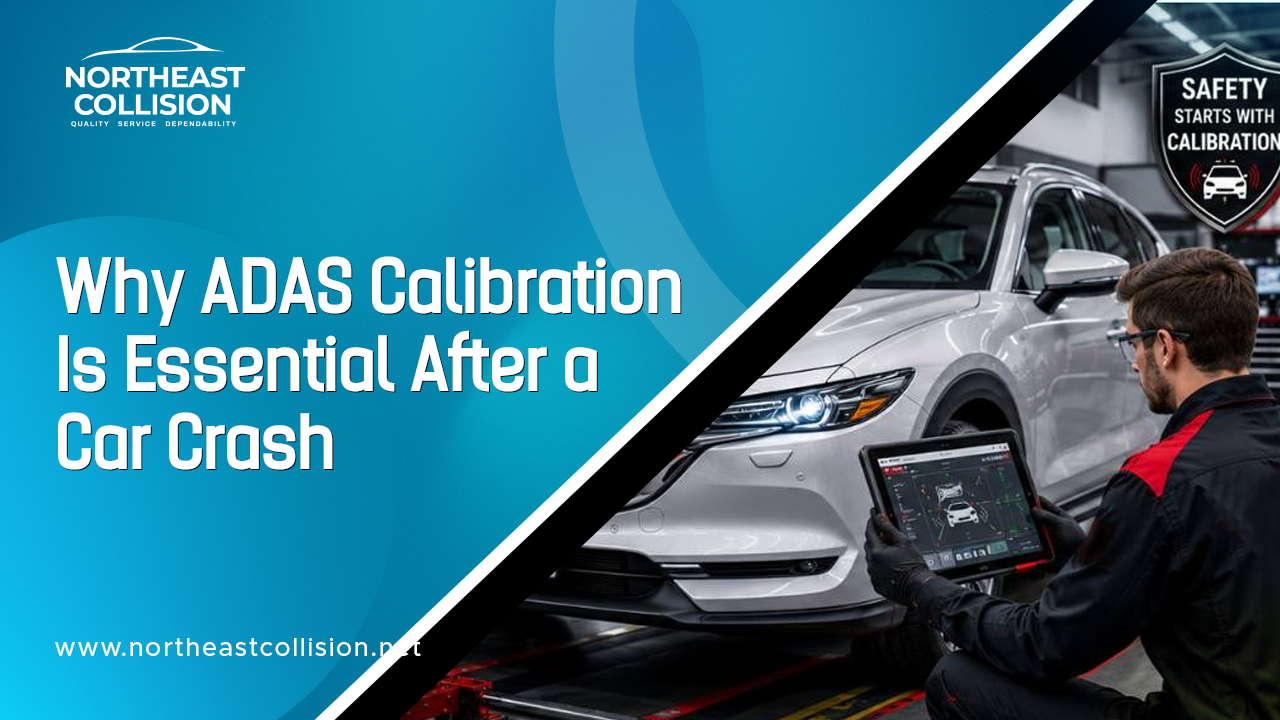
The most advanced equipment inside a modern collision repair center never actually touches raw metal. It lives entirely within the digital space. Your vehicle is packed with Advanced Driver Assistance Systems (ADAS)—the complex array of cameras, radar modules, and ultrasonic proximity sensors that manage your adaptive cruise control, lane-keep assist, and automatic emergency braking.
Whenever a bumper cover is removed for paint, a side mirror is detached, or a windshield is replaced, these safety sensors must undergo an exact recalibration routine.
- Static Calibration: Executed inside a perfectly level, specialized diagnostic bay. Technicians set up laser-aligned physical geometric targets around the vehicle to ensure cameras and radar units are tracking perfectly straight.
- Dynamic Calibration: Involves connecting an advanced diagnostic tablet directly to your vehicle’s computer brain and conducting a precise, on-road test drive so the active safety features can “learn” and map the road environment in real time.
Without this specialized calibration process, a physically repaired vehicle is fundamentally dangerous to drive, as its safety systems are effectively operating blind.
Why Advanced Equipment Protects Your Finances
It is natural to wonder why a facility equipped with advanced industrial machinery charges a premium compared to an uncertified mechanic working out of a residential garage. The answer comes down to financial preservation and accuracy:
- Accelerated Repair Turnaround: Advanced 3D measuring and pre-repair scanning allow our team to identify hidden structural and electronic damage on day one. This eliminates mid-repair surprises and allows us to source the correct OEM collision parts on the first order.
- Undetectable Resale Restoration: A structural frame restoration executed on a laser-guided rack combined with factory-spec spot welding is completely invisible to dealership vehicle appraisers. A manual, hammer-and-filler repair is incredibly easy to spot and will severely compromise your trade-in valuation.
- Uncompromised Safety Assurance: You cannot put a price tag on structural certainty. Utilizing advanced technology ensures that your vehicle’s engineered crumple zones and airbag deployment modules will function exactly as the manufacturer intended in a future accident.
The Human Expertise Behind the Technology
Even the most advanced industrial machinery is useless without a highly trained technician who knows how to interpret the digital data stream. At Northeast Collision, we combine cutting-edge automotive technology with continuous, rigorous industry training. We don’t just house the machines; our technicians master the exact automotive science required to operate them safely.
Is your modern vehicle ready for the road of tomorrow? Don’t gamble with your family’s safety by trusting an advanced vehicle to outdated manual repair methods. Contact Northeast Collision today to see how our advanced equipment restores your vehicle back to factory perfection.
Frequently Asked Questions (FAQs)
1. Does every local auto body shop have access to this level of equipment?
No, unfortunately not. Many budget-tier or uncertified body shops still rely on manual tape-measure assessments and basic, high-heat MIG welding torches. When researching repair facilities for your insurance claim, you should always explicitly ask if they utilize a 3D computerized frame-measuring system and perform full in-house ADAS calibrations.
2. Is repairing aluminum panels different from repairing standard steel?
Aluminum requires an entirely unique repair infrastructure. Aluminum lacks the structural “shape memory” of steel and transfers heat much more rapidly. To repair aluminum vehicles safely, a facility must utilize a dedicated aluminum clean room to prevent airborne steel dust from settling on the panels (which causes catastrophic galvanic corrosion). They also require specialized aluminum-welders and distinct dent-pulling work stations.
3. What exactly is a “Pre-Repair Scan”?
Think of a pre-repair scan as an initial digital health checkup for your car. We plug our diagnostic computer directly into your vehicle’s OBD-II port to read every internal module. This process builds a complete electronic map of your vehicle, discovering hidden system faults or sensor errors caused by the accident that haven’t triggered a dashboard warning light yet.
4. How can you guarantee a vehicle’s frame is straight down to a single millimeter?
Our 3D laser-measuring system provides a live, real-time data readout on our computer screens during the repair process. As our hydraulic towers apply controlled pressure to realign the unibody, the measuring targets track the movement across three dimensions. Once every single measurement point shifts from “red” to “green” on the technician’s screen, we know the vehicle’s structural skeleton has returned perfectly to factory zero.
5. Why must a vehicle enter a heated booth just for a paint job?
The intense heat inside a modern spray booth isn’t just about drying the paint quickly to speed up production. The high temperature triggers a vital chemical curing process within the clear coat, permanently hardening the molecules into a rock-hard, resilient shield. Letting automotive paint simply air-dry in a standard garage leaves the finish soft, making it an immediate magnet for paint chips, scratches, and environmental damage.
6. Am I allowed to request copies of the digital repair and alignment reports?
You absolutely should ask for them. A professional collision center that takes pride in its craftsmanship will be more than happy to print or email your laser-measuring alignment graphs and your digital ADAS calibration logs. These printouts serve as your official “receipt” for the invisible, structural work, proving that your car’s framework is geometrically perfect and its computer brain is completely free of error codes.