If you have ever tried to touch up a rock chip on your car using one of those tiny factory bottles from a dealership, you already know how frustrating it can be. You dab it on carefully, let it dry, and suddenly your vehicle has a bright “freckle” that stands out like a sore thumb.
Now, imagine trying to replicate that process across an entire door, fender, or hood following an accident.
Achieving a flawless, factory-quality paint match isn’t just about having a steady hand or pulling a vehicle color code. It is a highly sophisticated science involving advanced physics, digital technology, and the kind of meticulous eye for detail that only comes with years in the refinishing booth. In reality, flawless color matching is often the most demanding stage of any professional collision repairs.
It Starts with the Code (But Doesn’t End There)
Every vehicle leaves the assembly line with a specific paint code, typically located on a manufacturer’s sticker inside the driver-side door jamb or under the hood. For a DIY enthusiast, that code looks like the finish line. For an I-CAR Gold Class facility, it is barely the starting blocks.
The reason is simple: factory variation. Vehicles are not all painted at the same time or in a single facility. Car manufacturers paint vehicles in batches across different factories, frequently sourcing automotive paint from various suppliers. A specific metallic gray mixed at a plant in Kentucky may feature an incredibly subtle hue variance compared to the same color mixed at a plant in Mexico.
Furthermore, environmental factors change everything. After five years of exposure to New Jersey sun, acid rain, road salt, and harsh winter elements, that original factory code no longer represents the vehicle’s current shade.
The Digital Advantage: The Spectrophotometer
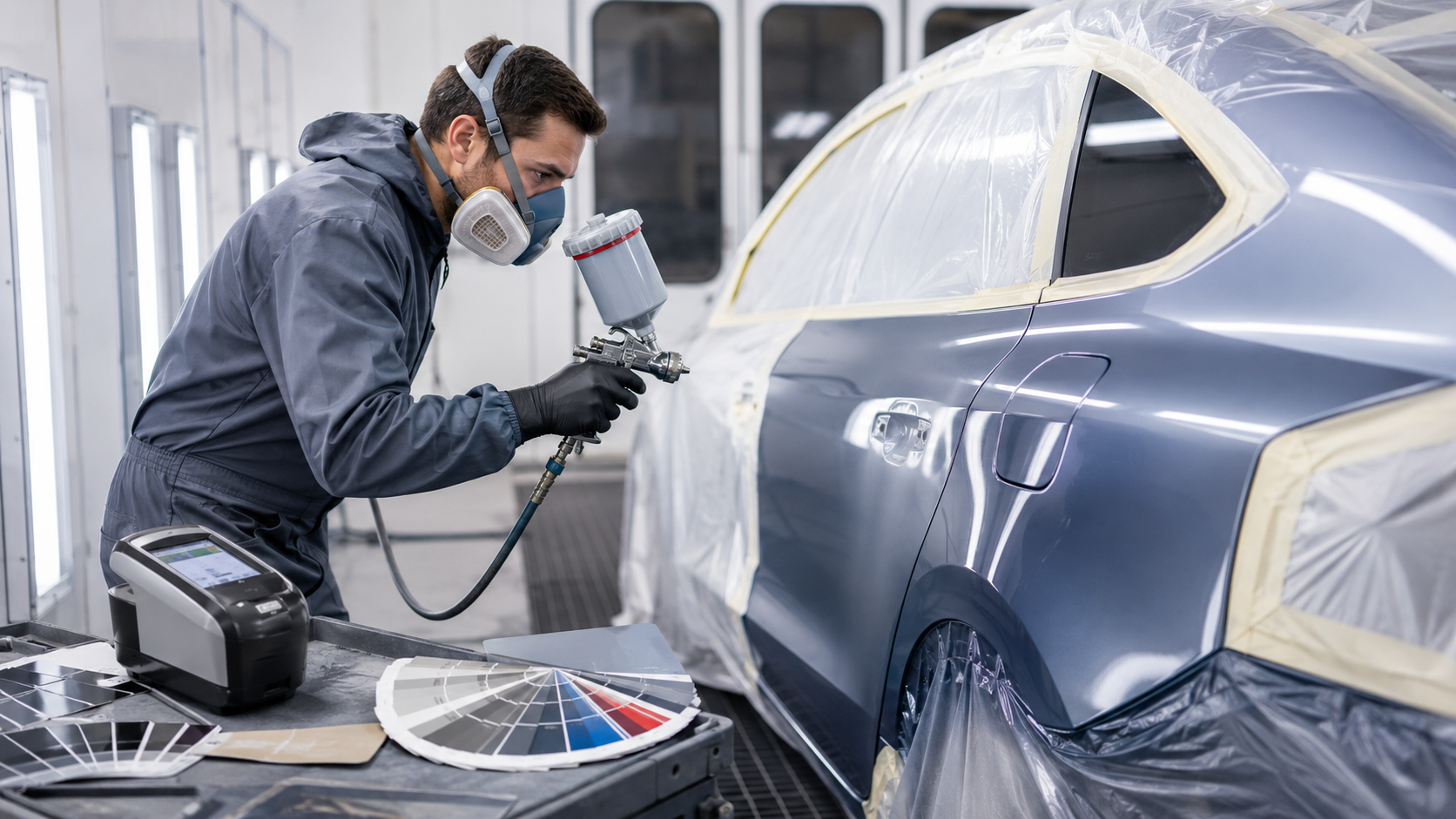
This is where the technology inside a modern facility like Northeast Collision changes the game. We completely eliminate the guesswork by utilizing a specialized digital device called a spectrophotometer.
Think of a spectrophotometer as a high-powered, multi-angle digital eye. When placed directly against your vehicle’s existing, aged paint, it takes precise digital measurements of how light bounces off the surface. It analyzes both the “flop” (how the color transitions as you move around it) and the “metallics” (the exact size and distribution of the tiny metallic flakes suspended in the paint).
This data is fed into a massive global paint database to formulate a mixture that matches your car’s current, real-world state, rather than its brand-new showroom state.
The Professional Auto Refinishing Process: Step-by-Step
Restoring a factory finish requires a multi-layered application of chemical engineering. Here is exactly how professional technicians achieve seamless results:
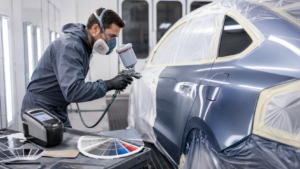
- The Spray-Out Card: Before a single ounce of paint is sprayed onto your vehicle, our painters create a “spray-out card.” We test-spray a small metal panel, allow it to dry completely under specialized curing lamps, and inspect it against your car in natural daylight. If the match isn’t absolute, our master painter manually “tints” the formula—adding a micro-drop of yellow to warm it up, or black to deepen the hue.
- The Art of the Blend: In high-quality auto body painting, you rarely paint only the single panel that was structurally damaged. If we replace a front fender, our technicians strategically blend the new base coat into the adjacent front door and hood. This creates a perfect optical illusion; the new paint subtly tapers into the old, making it impossible for the human eye to detect where the repair ends.
- The Clear Coat Factor: The ultimate depth and gloss of your car come from the clear coat layer, which can actually alter how the base color appears. If clear coat is applied too heavily, it can visually darken the paint below it. Professionals use specialized spray equipment to mirror the factory “millage” (thickness), ensuring the texture matches the rest of the vehicle.
Why “Close Enough” Isn’t Good Enough
While a 95% color match might sound acceptable in a garage, automotive paint is completely unforgiving. A subpar paint match may look decent under overcast skies, but the moment you pull under bright LED lighting or gas station structures at night, the mismatched panel will stand out dramatically.
- Metamerism: This is the scientific phenomenon where two colors appear identical under one light source (like indoor shop lights) but look entirely different under another (like direct sunlight or a sunset). Professional color matching accounts for this shift.
- Texture Matching (Orange Peel): Factory automotive paint possesses a subtle texture known as “orange peel.” If a repair facility sprays a door completely smooth while the rest of the car features a factory texture, light will reflect off the panels differently, exposing the repair.
- Preserving Resale Value: A “spotted” paint job acts as an immediate red flag for buyers and dealerships, signaling a history of accidents. A seamless match keeps your vehicle’s structural repairs invisible, protecting its equity.
The Challenge of Complex Finishes: Pearls and Tri-Coats
If you drive a vehicle featuring a luxury “Pearl White,” “Soul Red,” or deep metallic finish, your car utilizes a tri-coat process. These complex finishes consist of a base color coat, a translucent mid-coat infused with pearl flakes, and a final protective clear coat.
Matching a tri-coat requires elite craftsmanship. The final hue changes based on the exact speed, distance, and number of “passes” the technician makes with the spray gun. It requires a master painter who understands the precise flash times between layers—a level of execution that budget operations or DIY kits simply cannot deliver.
Need Expert Paint Correction or Collision Repair?
Whether your vehicle requires minor scratch paint repair or comprehensive structural restoration after an accident, don’t settle for “close enough.” At Northeast Collision, our I-CAR Gold Class certified technicians combine cutting-edge color-matching technology with decades of craftsmanship to deliver an invisible, factory-quality finish. Contact our Plainfield auto body shop today to schedule your free damage assessment.
Frequently Asked Questions (FAQs)
How long does it take for new auto body paint to fully cure?
While your vehicle’s paint is completely dry to the touch and safe to drive when you collect it from our shop, it takes roughly 30 to 60 days for the fresh solvents to fully “outgas” and harden. During this initial curing window, you should avoid commercial automated car washes and refrain from applying waxes or sealants.
Why does a newly painted plastic bumper sometimes look slightly different than a metal hood?
This is a well-known industry phenomenon. Automotive paint adheres, cures, and reflects light differently on plastic substrates (like bumpers) than it does on metal substrates (like fenders and hoods). In fact, you will often notice this subtle variance on brand-new vehicles straight from the factory. Professionals utilize specialized flex additives to match these pieces as closely as humanly possible.
Can custom paint finishes or paint protection layers be matched?
Yes, though custom finishes, matte paints, or candy coats require extensive manual color formulation and multiple test panels to accurately reverse-engineer the depth and layering.
Will the newly repaired paint fade faster than my factory paint?
No. In fact, modern premium clear coats offer significantly higher UV blockers and environmental resistance than factory finishes applied a decade ago. If properly maintained, the newly restored area will retain its gloss and structural integrity for years to come.
Does achieving a perfect paint match require stripping the old layers?
Yes, in the repair zone. We sand the damaged area down to the stable primer or raw substrate to eliminate any uneven ridges or edges. Our technicians then precision-build the primer, base coat, and clear coat layers up so that the repaired surface rests perfectly flush with the surrounding factory panels.