If you’ve ever stood in your driveway staring at a fresh dent or a deep scratch, you know the temptation. A quick trip to the auto parts store, a $40 dent-puller kit, and an aerosol can of “universal” color — and suddenly the idea of skipping the body shop feels very appealing. But before you start, it’s worth asking: is DIY auto body repair actually safe, or could it cost you far more in the long run?
This guide breaks down the real differences between professional and DIY repairs — covering structural safety, materials science, paint chemistry, and long-term value. If your vehicle has sustained any damage — from a minor ding to a serious collision — here’s what you need to know before deciding how to handle it.
Modern Vehicles Are Engineered Differently Than You Think
Today’s vehicles are no longer built from a single material. A single car may combine high-strength steel, aluminum alloy panels, carbon fiber reinforcements, and multiple grades of engineered plastics — all bonded and welded together in ways that require specific tools and training to repair correctly.
The Aluminum Challenge
Aluminum has become a go-to material for hoods, doors, and fenders thanks to its strength-to-weight ratio. However, aluminum has “no memory” — meaning it doesn’t flex back the way mild steel does. If you attempt to pull a dent in an aluminum panel without professional induction heating equipment, you risk cracking the metal entirely. What started as a repairable dent becomes a full panel replacement, costing significantly more than a professional auto body repair would have.
Composite and Plastic Panels
Modern bumpers and trim pieces are typically manufactured from TPO (thermoplastic polyolefin) or similar engineered plastics. Bonding paint to these materials requires professional-grade adhesion promoters and flex additives that simply aren’t available in consumer spray cans. Without these chemicals, paint will flake off under the vibration of normal highway driving — often within weeks of a DIY repair.
The Hidden Danger: Your Car’s Safety Systems
This is where DIY repair moves from an aesthetic issue to a genuine safety risk. Nearly every vehicle manufactured in the past five years includes Advanced Driver Assistance Systems (ADAS). These systems use a network of sensors, radars, and cameras embedded throughout your vehicle’s body — and they are highly sensitive to repair quality.
Common ADAS components concealed within body panels include:
• Blind-spot monitoring sensors hidden behind rear bumper covers
• Adaptive cruise control radar built into the front grille or bumper
• Lane-departure warning cameras that depend on precise hood and windshield alignment
• Automatic emergency braking systems tied to front-facing radar units
A certified collision repair center ensures that any material added during a repair — filler, paint, clear coat — does not interfere with radar signal transparency. Critically, following any body repair, these systems require a professional digital recalibration process. A sensor misaligned by just a fraction of a degree can cause your vehicle to fail to brake automatically in an emergency.
No DIY kit on the market includes the diagnostic software needed to verify that your ADAS sensors are calibrated correctly after a repair. This is not a cosmetic concern — it is a life-safety issue.
Why a ‘Factory Finish’ Is Impossible in Your Driveway
Professional refinishing is a controlled industrial process. Achieving a result that’s indistinguishable from the original factory finish requires environmental and chemical precision that a home setting simply cannot replicate.
Spray Booth Technology
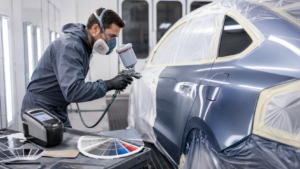
Professional shops refinish vehicles inside “down-draft” spray booths — sealed, climate-controlled environments that pull air through HEPA-grade filters to eliminate every microscopic particle of dust. In an open garage or driveway, static electricity turns your car’s panels into a magnet for airborne debris. Even a single dust particle in the base coat creates a “fish-eye” or surface nib that damages the clear coat’s reflective quality and creates a point of future failure.
Our auto body painting services are performed in a professional spray environment, ensuring the kind of flawless, showroom-quality finish your vehicle deserves.
2K vs. 1K Clear Coats
Professional-grade 2K (two-component) clear coats use a chemical hardener that creates a durable, UV-resistant shield. Consumer aerosol products are 1K (single-component) — they dry by simple evaporation, producing a soft, porous finish that typically begins to dull, yellow, or peel within months.
Computerized Color Matching
Your car’s paint has aged. Even if you have the factory paint code, environmental exposure — UV radiation, acid rain, road salt — has shifted the pigment chemistry of every original panel. Professional shops use spectrophotometers to scan your car’s current paint and create a custom-tinted formula that accounts for this real-world aging. No aerosol can, regardless of the code on the label, can replicate this.
Structural Integrity and Frame Safety
After a significant impact, visible body damage is often the least of your concerns. Modern vehicles use a “unibody” structure in which the body panels are integral to the vehicle’s crash protection engineering. Hidden frame damage — a bent rail, a shifted crumple zone, a compromised structural weld — can make a vehicle unsafe without any outward sign.
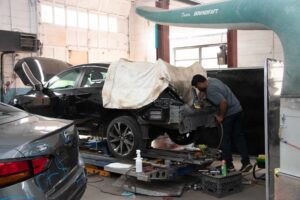
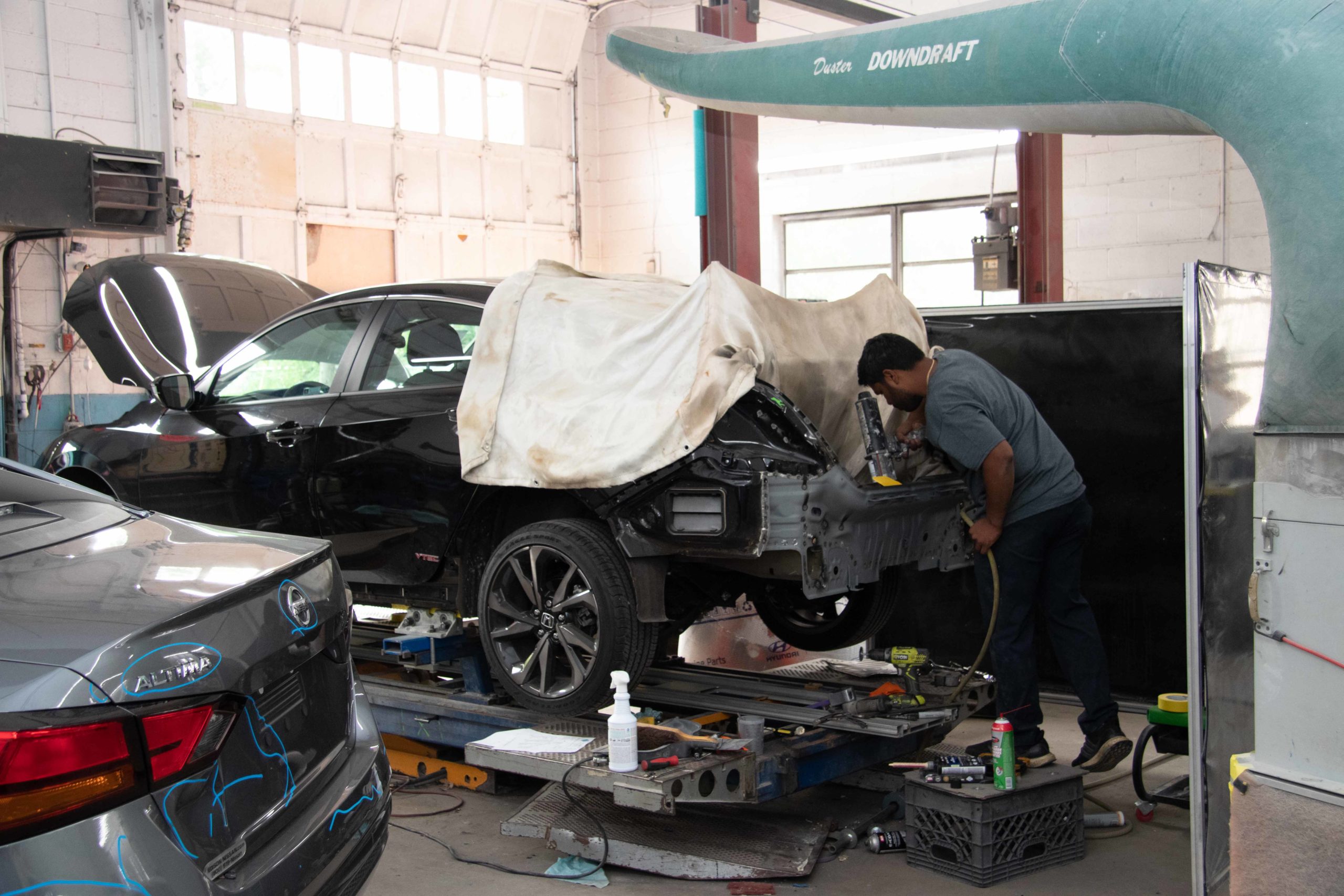
Our frame repair technicians use laser-guided measurement systems to restore your vehicle’s unibody geometry to within a millimeter of factory specification. This matters not just for safety, but for tire longevity, suspension performance, and proper wheel alignment.
Similarly, structural damage repair requires precisely calibrated spot welding that replicates the factory’s structural integrity. An incorrect weld — too hot, too cold, or placed incorrectly — weakens the metal at that point, potentially compromising the vehicle’s ability to protect occupants in a future collision.
The Financial Case for Professional Repair
The immediate cost of a DIY kit is undeniably lower. But the long-term financial picture looks very different.
The Trade-In Penalty
When you sell or trade in your vehicle, appraisers are trained to identify inconsistent paint texture (known as “orange peel”), mismatched color under direct light, and overspray on rubber trim or glass. A visible DIY repair signals to buyers and dealers that the vehicle was maintained without professional standards — often resulting in a valuation reduction that exceeds what a professional repair would have cost in the first place.
The Double-Repair Problem
A significant portion of professional collision center work involves correcting failed DIY attempts. When body filler is applied improperly, rust forms underneath it. When 1K paint is used, it delaminates. Correcting these failures requires the technician to strip the entire affected area back to bare metal before beginning the correct repair — adding labor hours and cost that would not have existed had the repair been done professionally from the start.
Paintless Dent Repair: Where DIY Falls Furthest Short
Paintless Dent Repair (PDR) is a highly skilled technique that allows technicians to massage dents out from behind the panel without using filler or paint — preserving your original factory finish entirely. While consumer PDR kits exist, the technique requires years of hands-on training to master the pressure gradients needed to avoid creating “high spots” or cracking the paint from the inside. Our paintless dent repair service is performed by trained technicians and is ideal for minor dents, door dings, and hail damage.
Likewise, our scratch repair services address everything from surface scuffs to deep scratches that have penetrated the primer or metal. Left unrepaired, scratches that reach bare metal allow moisture and road salt to begin the oxidation process — and rust spreads structurally, not just cosmetically.
What a Certified Collision Center Actually Provides
A certified collision center is a specialized facility with industrial infrastructure that simply cannot be replicated at home or in a standard garage. At Northeast Collision in Plainfield, NJ, our shop includes:
• Computerized spectrophotometer color-matching for precise, age-adjusted paint formulas
• Laser-guided frame and unibody measurement systems
• Certified structural welding equipment calibrated to OEM specifications
• Professional down-draft spray booths for dust-free refinishing
• ADAS diagnostic and recalibration equipment
• Insurance documentation support for seamless claims processing
We proudly serve drivers throughout Plainfield, NJ and surrounding communities including Woodbridge, Watchung, Scotch Plains, Fanwood, Westfield, Edison, Cranford, and beyond. Visit our service areas page to see if we cover your location.
Ready to Get a Professional Estimate?
Don’t leave your vehicle’s safety and value to chance. Whether you’re dealing with a minor dent, a deep scratch, or significant collision damage, the certified technicians at Northeast Collision in Plainfield, NJ are ready to restore your car to pre-accident condition — with the precision and quality it deserves. We work with all major insurance providers and offer a fast turnaround for drivers across Union, Middlesex, and Somerset counties.Contact us today or visit our collision repair services page to schedule your free estimate. Serving Plainfield, Scotch Plains, Fanwood, Westfield, Woodbridge, Watchung, and all surrounding areas.
Frequently Asked Questions
How can I tell if a previous repair was done by a professional?
Look for overspray on rubber trim, tires, or glass. Examine the color under direct sunlight from multiple angles. Run your hand down the panel to feel for wavy texture or irregular surface feel. A professional repair should be completely indistinguishable from the factory finish.
Does auto insurance cover professional bodywork for minor damage?
In many cases, yes — depending on your deductible and the nature of the damage. It’s always worth getting a professional estimate first. Our team works directly with all major insurance carriers and can help determine whether filing a claim is the right financial decision for your situation.
Can small scratches really cause rust?
Absolutely. Your vehicle’s paint system acts as a protective barrier for the metal beneath. Once a scratch penetrates the galvanized coating, moisture and road salt begin the oxidation process immediately. Our scratch repair service seals the metal and restores your finish before rust has a chance to spread.
Why isn’t the factory paint code enough to match my paint exactly?
Factory paint codes represent the original formula, but every vehicle’s paint changes over time due to UV exposure, acid rain, and road contaminants. Professional shops use spectrophotometer technology to scan your actual panels and create a custom-adjusted formula — ensuring a seamless match with the rest of your car.
What is the difference between a collision repair center and a regular auto shop?
A certified collision center specializes in structural and cosmetic vehicle restoration following accidents. Unlike a general auto repair shop, a collision center is equipped with frame straightening systems, OEM-grade welding tools, professional spray booths, ADAS calibration equipment, and color-matching technology.